

Restoration and Study of the Polychrome Wooden Sarcophagus of Amenirdis (Case and Lid)
Date: c. 9th century B.C., 22nd Dynasty
Materials: polychrome wood
Adopted By: The Côte d'Azur - Principality of Monaco Chapter
Description
NORMAL PRIORITY PROJECT
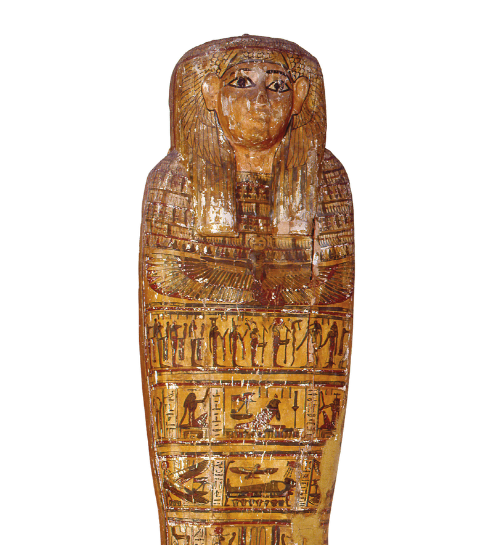
The sarcophagus, which still contained the mummy, became part of the Egyptian Gregorian Museum’s collection in 1841 founded by Pope Gregory XVI in 1839. The sarcophagus belonged to a priestess named Amenirdis, who was probably originally from Thebes. Both the case and the lid are constructed from long planks of sycamore fig wood, and the entire sarcophagus is painted with iconographies that grant the deceased an afterlife. The central register on the lid, for example, depicts the deceased on her funeral bed receiving the rays of the sun god Ra, a symbol of regeneration, while her Ba flies above her, granting her transfiguration into a divine being. The Ba is the transcendent and spiritual part traceable to a person’s soul. It is an essence that is subject to permanence in the spiritual world. Its power could be multiplied by that of its holder. The Ba would leave the body of the deceased and return to it after mummification. The conservation intervention for this sarcophagus is part of the Vatican Coffin Project, the international project launched in 2007 by the Department of Egyptian and Near Eastern Antiquities and the Scientific Research Laboratory of the Vatican Museums, which aims to study polychrome wooden sarcophagi.
Total Cost: € 44.548,00 ($ 52.415,18)
State of Preservation
The wooden structure appears solid overall, despite evidence of the bonding systems loosening at the joints that make up the head. Significant disconnections are evident at the joints. Some parts show cracks, which are probably due to natural wood movement. The preparatory and pictorial layers are severely damaged by gaps and abrasions spread across the entire artefact, particularly along the lower edge of the left side. Small gaps confined to the outer edges of the sides are probably due to manipulation and handling. More or less coherent particulate deposits are present across the entire surface.
Restoration Procedures
- Localized consolidation of any decohesion of the wooden bracket
- Study and revision of the assemblies between the wooden elements of the support, to remove the screwed restoration brackets and designing and create a new assembly/support structure
- Bonding wood cracks by the localized application of synthetic vinyl adhesive
- Consolidation of partially decohered pictorial layers
- Restoration of the adhesion of the pictorial layers
- Mechanical and chemical cleaning of surfaces
- Solubility tests to identify solvent mixtures or aqueous solutions that can remove surface-altered substances without altering the original materials
- Review and removal of adhesives from previous restoration work, if needed
- Possible filling of minor and medium-sized gaps using filler mixtures tested as part of the Vatican Coffin Project
- Possible pictorial reintegration by plastering with watercolors for aesthetic restoration
Detail
Date: c. 9th century B.C., 22nd Dynasty
Materials: polychrome wood
Department:
Egyptian and Near Eastern Antiquitiesmuseum:
Gregorian Egyptian MuseumWishbook year: 2026

Restoration and Study of the Polychrome Wooden Sarcophagus of Amenirdis (Case and Lid)
Details
Adopted by: The Côte d'Azur - Principality of Monaco Chapter
Patrons: Liana Marabini
Date: c. 9th century B.C., 22nd Dynasty
Materials: polychrome wood
Museum: Gregorian Egyptian Museum
Department: Egyptian and Near Eastern Antiquities
Laboratory: Metals & Ceramics, Painting & Wood, Scientific Research
Wishbook year: 2026
Description
NORMAL PRIORITY PROJECT
The sarcophagus, which still contained the mummy, became part of the Egyptian Gregorian Museum’s collection in 1841 founded by Pope Gregory XVI in 1839. The sarcophagus belonged to a priestess named Amenirdis, who was probably originally from Thebes. Both the case and the lid are constructed from long planks of sycamore fig wood, and the entire sarcophagus is painted with iconographies that grant the deceased an afterlife. The central register on the lid, for example, depicts the deceased on her funeral bed receiving the rays of the sun god Ra, a symbol of regeneration, while her Ba flies above her, granting her transfiguration into a divine being. The Ba is the transcendent and spiritual part traceable to a person’s soul. It is an essence that is subject to permanence in the spiritual world. Its power could be multiplied by that of its holder. The Ba would leave the body of the deceased and return to it after mummification. The conservation intervention for this sarcophagus is part of the Vatican Coffin Project, the international project launched in 2007 by the Department of Egyptian and Near Eastern Antiquities and the Scientific Research Laboratory of the Vatican Museums, which aims to study polychrome wooden sarcophagi.
Total Cost: € 44.548,00 ($ 52.415,18)
State of Preservation
The wooden structure appears solid overall, despite evidence of the bonding systems loosening at the joints that make up the head. Significant disconnections are evident at the joints. Some parts show cracks, which are probably due to natural wood movement. The preparatory and pictorial layers are severely damaged by gaps and abrasions spread across the entire artefact, particularly along the lower edge of the left side. Small gaps confined to the outer edges of the sides are probably due to manipulation and handling. More or less coherent particulate deposits are present across the entire surface.
Restoration Procedures
- Localized consolidation of any decohesion of the wooden bracket
- Study and revision of the assemblies between the wooden elements of the support, to remove the screwed restoration brackets and designing and create a new assembly/support structure
- Bonding wood cracks by the localized application of synthetic vinyl adhesive
- Consolidation of partially decohered pictorial layers
- Restoration of the adhesion of the pictorial layers
- Mechanical and chemical cleaning of surfaces
- Solubility tests to identify solvent mixtures or aqueous solutions that can remove surface-altered substances without altering the original materials
- Review and removal of adhesives from previous restoration work, if needed
- Possible filling of minor and medium-sized gaps using filler mixtures tested as part of the Vatican Coffin Project
- Possible pictorial reintegration by plastering with watercolors for aesthetic restoration
© 2026 Patrons of the Arts
in the Vatican Museums
Vatican Museums V-00120,
Vatican City State (Europe)
+39 0669864499