

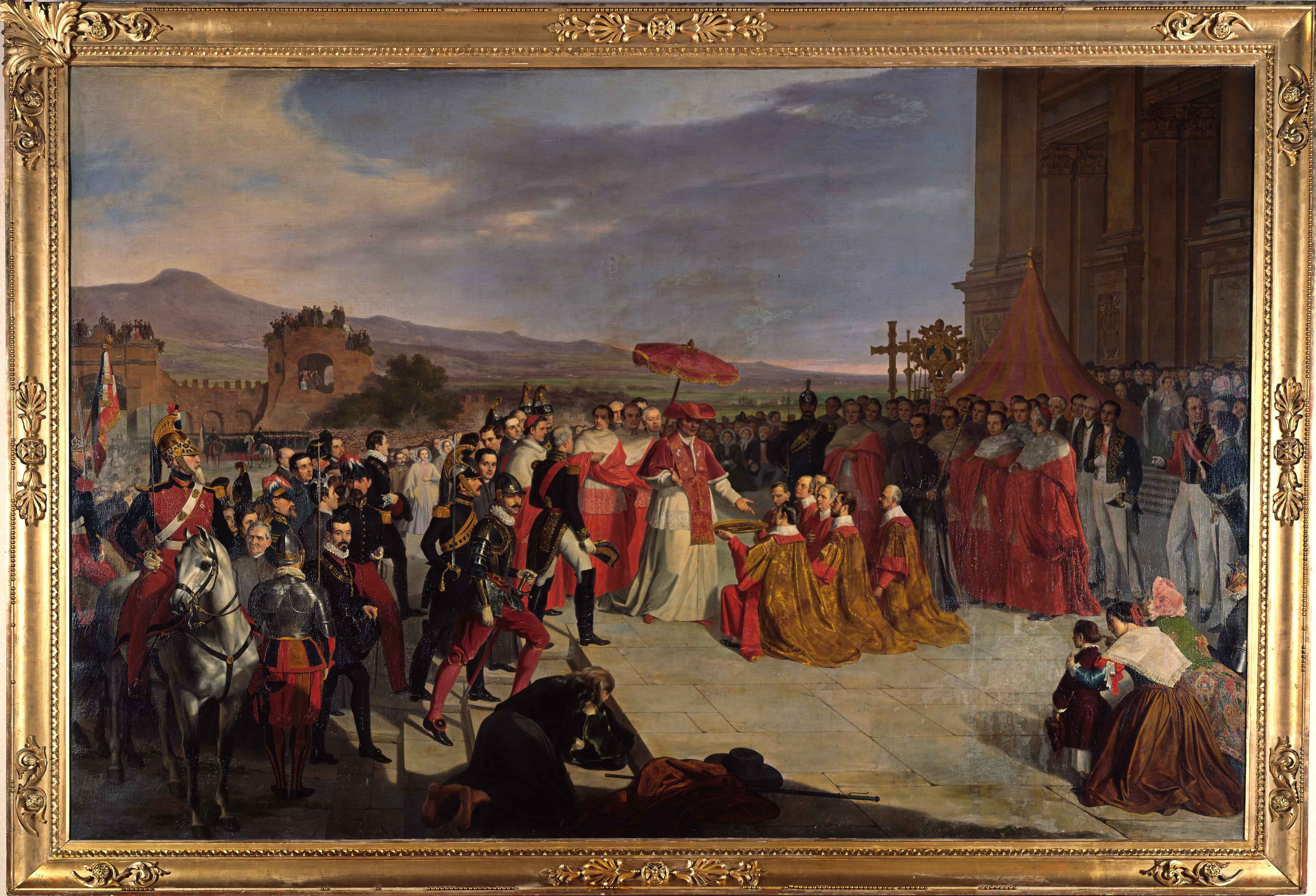
Pius IX takes repossession of the city of Rome and the Lateran Basilica
Artist: Carlo de Paris
Date: 1850
Classification: Painting
Dimensions: 207 x 269 cm
Materials: Canvas, Paint, Wood
Adopted By: The California Chapter
Description
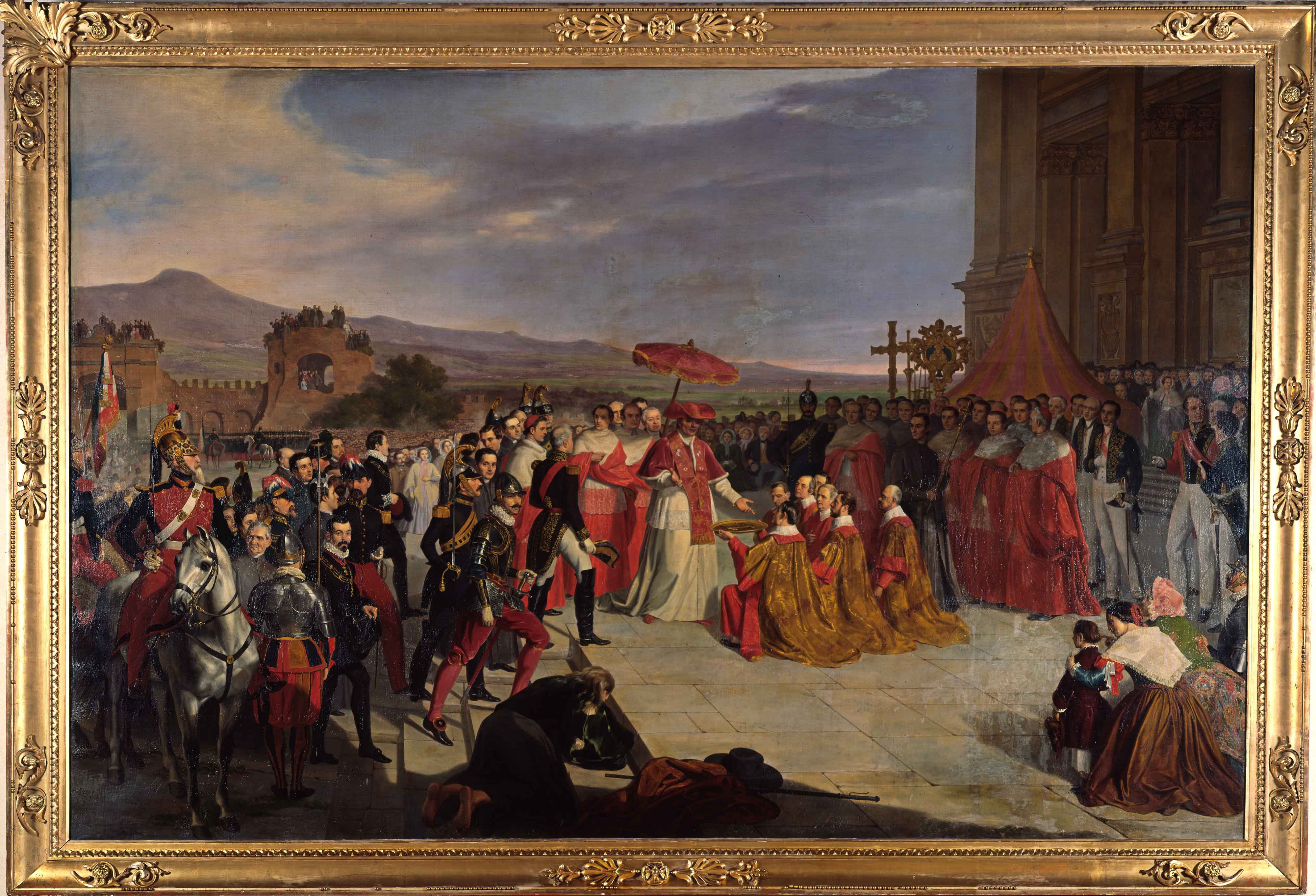
After the capitulation of the Roman Republic (during which Pope Pius IX remained in exile in Naples as a guest of King Ferdinand II), the Sovereign Pontiff was able to return to Rome and eventually arrived on April 12, 1850. This large canvas by Spanish artist Carlo De Paris represents the precise moment in which the Pontiff triumphantly arrives in the square affront of the Basilica of St. John Lateran. The clergy and governors of the city are outfitted in brocaded robes of crimson and gold (distinctive of their authority) and are seen welcoming the Pope by offering him on bended knee the keys of Rome on a silver platter. This scene depicting the “the repossession” is particularly rich in detail: the watchful gaze of the welcoming crowd, the vigilant presence of the nobility, the stately Pontifical Swiss Guard, and the onward-looking Canons of St. John. All are represented outside the Basilica in striking detail along with the bell and most precious ancient Lateran Cross. The importance of this work is easily recognizable, as it practically documents in “photographic” detail and precision this momentous event in the history of the Papacy in Rome.
State of Preservation
The work, before restoration, showed a problematic state of preservation. In particular, there were visibly altered touch-ups and some misshaping of the stretcher on the right side of the painting. In correspondence with the retouching and deformations, there was evidence of previous lacerations which were visible on the back; these involved new cloth inserts and were applied with hot glue. It is probable that, during the repair work, the glue was accidentally poured on the canvas and the high temperature irreparably damaged the pictorial layer: this subsequently justified the grouting and retouching. The areas affected by these damages concern the Cardinals in the vicinity of the Lateran Basilica, the last of the kneeling figures, the child with his mother, and part of the road pavement. The face of Pius IX was also involved in the areas that had to be repaired and his physiognomy was completely altered by retouching. The canvas had been previously fully re-stretched. An older restorative varnish, now opaque and yellowed, had modified the original color. The wooden stretcher of the picture was still functional for the mechanical tension of the canvas (using angular wedges). The work was dirty and had a poorly preserved gilt frame.
Restoration Procedures
When the painting was transferred to the Painting Restoration Laboratory, the frame and stretcher were immediately treated with Antitone, a biocidal product to treat woodworms, and was applied by brush. The greasy powder on the paint layer was removed with a high absorption sponge soaked in water. It was then wiped over the canvas to remove the paint and retouches, using a mixture of chemical solvents that had been previously tested. The removal of these overlapping layers revealed a discreet state of preservation of the original pictorial layer, except the areas already mentioned. The removal of the retouching proved to be simple and permitted appreciation for the actual state of the painting and those parts involved in the hot glue reparations. The few gaps in the pictorial layers have been rehabilitated with Bologna plaster and rabbit glue. The old plastering and the former reparations of the canvas were not removed because they were still stable, even if there were some superficial irregularities and situations of fragility on the edges. The latter was treated with an acrylic adhesive. To flatten the misshaping of the canvas support, a mechanical pressure was exerted through the use of magnets and two layers of plexiglass placed on the pictorial layer and the back of the painting. The pictorial reintegration was carried out using colored acrylic tempera paints. Finally, the work was protected with a layer of transparent spray varnish.
Scientific Analysis
The Vatican Museums’ Diagnostic Laboratory for Preservation and Restoration has carried out a series of scientific images (UV and IR) and a high definition IR reflectography, limited to the face of Pius IX which was damaged by glue and retouches. These analyses made it possible to detect the presence of gaps, the original preparatory drawing and what remains of the pope's face. Scientific investigations were very useful for the pictorial reconstruction of the face, following what would have been the original version of the painting.
Photographic Documentation
The Photographic Laboratory of the Vatican Museums made a complete digital photographic documentation of the state of preservation of the painting before the restoration, the preliminary cleaning tests and the painting at the end of the intervention. Photographic footage of the process was also carried out by the restorer responsible for the work.
Materials used in the restoration
- Treatment for woodworks, frame and stretcher: XiRein Bresciani s. r. l.
- For cleaning of the painting: Diacetonalcohol (22%) and ethyl alcohol (78%)
- Intermediate varnishing: Varnish extra-fine, Lefranc & Bourgeois
- Chromatic base for painting retouching: Acrylic tempera Liquitex
- Pictorial reintegration:Maimeri color paints
- Final varnishing: Varnish extra-fine, Lefranc & Bourgeois
Detail
Adopted By:
The California ChapterInventory N°: 43486
Artist: Carlo de Paris
Date: 1850
Dimensions: 207 x 269 cm
Materials: Canvas, Paint, Wood
Department:
Historical CollectionsCurators:
Dr. Sandro Barbagallomuseum:
Carriage PavilionLaboratories:
Painting & WoodWishbook year: 2017

Pius IX takes repossession of the city of Rome and the Lateran Basilica
Details
Adopted by: The California Chapter
Inventory: 43486
Artist: Carlo de Paris
Date: 1850
Classification: Painting
Materials: Canvas, Paint, Wood
Dimensions: 207 x 269 cm
Museum: Carriage Pavilion
Department: Historical Collections
Laboratory: Painting & Wood
Wishbook year: 2017
Description
After the capitulation of the Roman Republic (during which Pope Pius IX remained in exile in Naples as a guest of King Ferdinand II), the Sovereign Pontiff was able to return to Rome and eventually arrived on April 12, 1850. This large canvas by Spanish artist Carlo De Paris represents the precise moment in which the Pontiff triumphantly arrives in the square affront of the Basilica of St. John Lateran. The clergy and governors of the city are outfitted in brocaded robes of crimson and gold (distinctive of their authority) and are seen welcoming the Pope by offering him on bended knee the keys of Rome on a silver platter. This scene depicting the “the repossession” is particularly rich in detail: the watchful gaze of the welcoming crowd, the vigilant presence of the nobility, the stately Pontifical Swiss Guard, and the onward-looking Canons of St. John. All are represented outside the Basilica in striking detail along with the bell and most precious ancient Lateran Cross. The importance of this work is easily recognizable, as it practically documents in “photographic” detail and precision this momentous event in the history of the Papacy in Rome.
State of Preservation
The work, before restoration, showed a problematic state of preservation. In particular, there were visibly altered touch-ups and some misshaping of the stretcher on the right side of the painting. In correspondence with the retouching and deformations, there was evidence of previous lacerations which were visible on the back; these involved new cloth inserts and were applied with hot glue. It is probable that, during the repair work, the glue was accidentally poured on the canvas and the high temperature irreparably damaged the pictorial layer: this subsequently justified the grouting and retouching. The areas affected by these damages concern the Cardinals in the vicinity of the Lateran Basilica, the last of the kneeling figures, the child with his mother, and part of the road pavement. The face of Pius IX was also involved in the areas that had to be repaired and his physiognomy was completely altered by retouching. The canvas had been previously fully re-stretched. An older restorative varnish, now opaque and yellowed, had modified the original color. The wooden stretcher of the picture was still functional for the mechanical tension of the canvas (using angular wedges). The work was dirty and had a poorly preserved gilt frame.
Restoration Procedures
When the painting was transferred to the Painting Restoration Laboratory, the frame and stretcher were immediately treated with Antitone, a biocidal product to treat woodworms, and was applied by brush. The greasy powder on the paint layer was removed with a high absorption sponge soaked in water. It was then wiped over the canvas to remove the paint and retouches, using a mixture of chemical solvents that had been previously tested. The removal of these overlapping layers revealed a discreet state of preservation of the original pictorial layer, except the areas already mentioned. The removal of the retouching proved to be simple and permitted appreciation for the actual state of the painting and those parts involved in the hot glue reparations. The few gaps in the pictorial layers have been rehabilitated with Bologna plaster and rabbit glue. The old plastering and the former reparations of the canvas were not removed because they were still stable, even if there were some superficial irregularities and situations of fragility on the edges. The latter was treated with an acrylic adhesive. To flatten the misshaping of the canvas support, a mechanical pressure was exerted through the use of magnets and two layers of plexiglass placed on the pictorial layer and the back of the painting. The pictorial reintegration was carried out using colored acrylic tempera paints. Finally, the work was protected with a layer of transparent spray varnish.
Scientific Analysis
The Vatican Museums’ Diagnostic Laboratory for Preservation and Restoration has carried out a series of scientific images (UV and IR) and a high definition IR reflectography, limited to the face of Pius IX which was damaged by glue and retouches. These analyses made it possible to detect the presence of gaps, the original preparatory drawing and what remains of the pope's face. Scientific investigations were very useful for the pictorial reconstruction of the face, following what would have been the original version of the painting.
Photographic Documentation
The Photographic Laboratory of the Vatican Museums made a complete digital photographic documentation of the state of preservation of the painting before the restoration, the preliminary cleaning tests and the painting at the end of the intervention. Photographic footage of the process was also carried out by the restorer responsible for the work.
Materials used in the restoration
- Treatment for woodworks, frame and stretcher: XiRein Bresciani s. r. l.
- For cleaning of the painting: Diacetonalcohol (22%) and ethyl alcohol (78%)
- Intermediate varnishing: Varnish extra-fine, Lefranc & Bourgeois
- Chromatic base for painting retouching: Acrylic tempera Liquitex
- Pictorial reintegration:Maimeri color paints
- Final varnishing: Varnish extra-fine, Lefranc & Bourgeois
Media
Pius IX takes repossession of the city of Rome and the Lateran Basilica - Before Restoration
© 2026 Patrons of the Arts
in the Vatican Museums
Vatican Museums V-00120,
Vatican City State (Europe)
+39 0669864499