

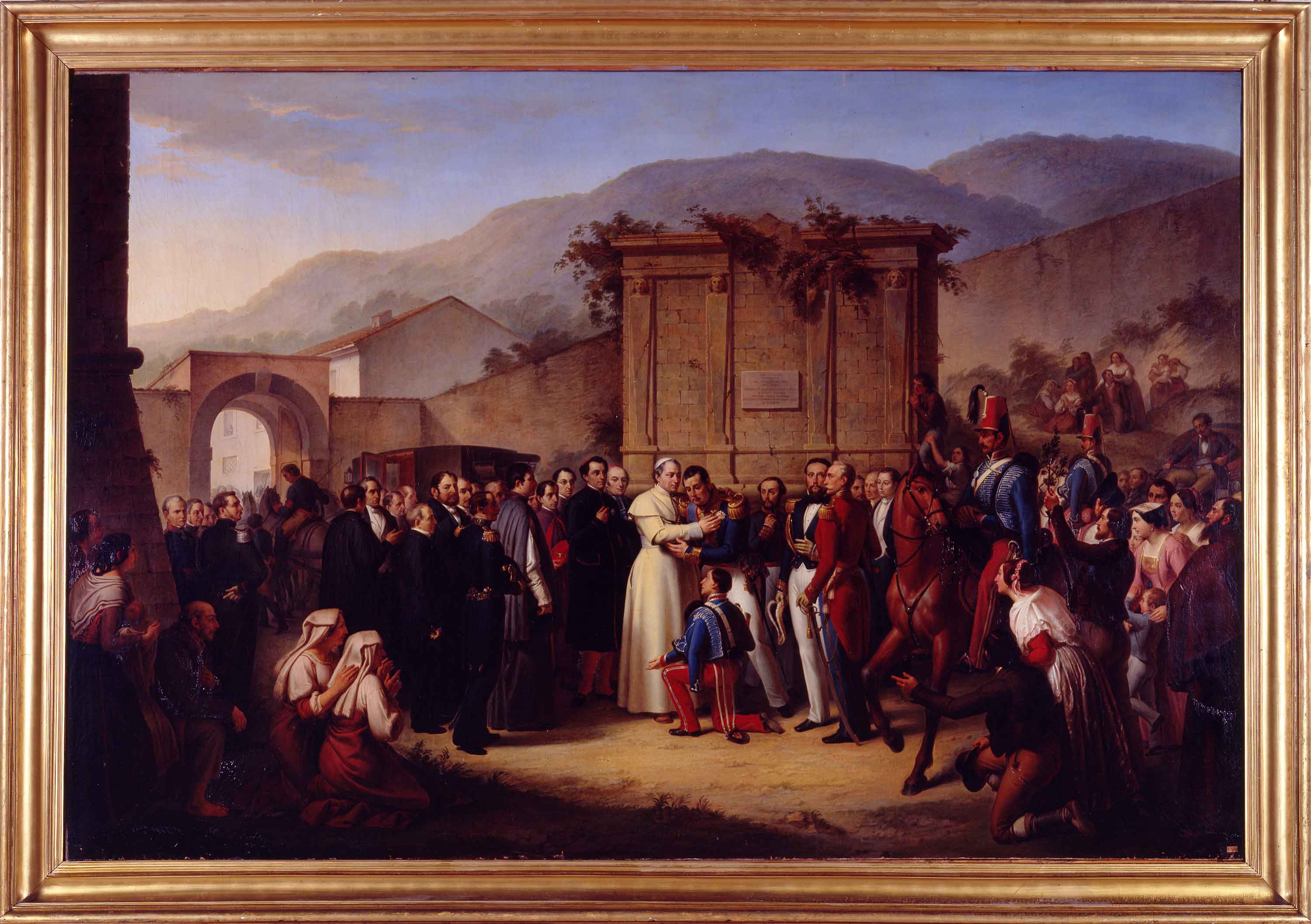
The Farewell of Pope Pius IX to Ferdinand II after the Neapolitan exile
Artist: Filippo Bigioli
Date: 1885
Classification: Painting
Dimensions: 192 x 270 cm
Materials: Canvas, Painti, Wood
Adopted By: The California Chapter
Description
Commissioned by Cardinal Giacomo Antonelli, this great commemorative canvas was painted by artist Filippo Bigilio from Italy’s Marche region. The painting represents the cordial salutation and gratitude of Pope Pius IX to the King of Naples for his hospitality. The riots during the Roman Republic were particularly grave, to the extent that they resulted in the killing of the Prime Minister of the Papal States. Following the riots, on November 24, 1848, Pope Pius IX was forced to flee clandestinely from Rome, taking refuge in Gaeta. That very night, disguised as a simple priest, the Pope succeeded in flight from the Quirinale. In an enclosed carriage along with his secret assistant, he escaped capture and traveled to the countryside, despite all obstacles including a cannon ready to fire at the main gate of the Papal Palace. Finally, he arrived at the church of Saints Peter and Marcellinus via Labicana. Here the Holy Pontiff found the Bavarian Ambassador Count Karl von Spaur waiting with his wife and son, who together feigned going on a sightseeing tour in the Kingdom of Naples accompanied by their new “docent.” The Pope hopped into the Ambassador’s carriage on the evening of November 25th and arrived undisturbed in Gaeta where he wrote these words to Ferdinand II: “The Supreme Roman Pontiff has found himself in a position where he must abandon the capital of his domain to not compromise his dignity. He is now in Gaeta, yet only for a brief time, wherein it is by no means intended to compromise in any way your Majesty nor the tranquility of your people.” Moved by these words, Ferdinand II left Naples with his family and headed to Gaeta, and invited the Pope to move into his Villa in Portici, where Pope Pius IX remained until April 4, 1850. After the capitulation of the Roman Republic, the Sovereign Pontiff was able once again to return to Rome. King Ferdinand II accompanied the Pope personally out of the confines of the state border, where his Majesty had prepared the Carrozza da Viaggio (Inv. No. 45572) to transport him on his journey. It is seen depicted in the background of the painting, and the actual carriage is on display in the Carriage Museum in the Vatican. This canvas by Filippo Bigioli is an extremely important job, as it pictorially documents a momentously definitive time in Papal history.
State of Preservation
Restoration Procedures
-
Anti-infestation measures
-
Checking of the state of the canvas and intervention
-
Cleaning of the pictorial layer and removal of the previews restorative interventions
-
Cleaning and consolidation of the pictorial surfaces
-
Touching-up of the pictorial and gift surfaces
-
Photographic documentation
-
Application of varnishes
Detail
Adopted By:
The California ChapterInventory N°: 42643
Artist: Filippo Bigioli
Date: 1885
Dimensions: 192 x 270 cm
Materials: Canvas, Painti, Wood
Department:
Historical CollectionsCurators:
Dr. Sandro Barbagallomuseum:
Carriage PavilionLaboratories:
Painting & WoodWishbook year: 2017

The Farewell of Pope Pius IX to Ferdinand II after the Neapolitan exile
Details
Adopted by: The California Chapter
Inventory: 42643
Artist: Filippo Bigioli
Date: 1885
Classification: Painting
Materials: Canvas, Painti, Wood
Dimensions: 192 x 270 cm
Museum: Carriage Pavilion
Department: Historical Collections
Laboratory: Painting & Wood
Wishbook year: 2017
Description
Commissioned by Cardinal Giacomo Antonelli, this great commemorative canvas was painted by artist Filippo Bigilio from Italy’s Marche region. The painting represents the cordial salutation and gratitude of Pope Pius IX to the King of Naples for his hospitality. The riots during the Roman Republic were particularly grave, to the extent that they resulted in the killing of the Prime Minister of the Papal States. Following the riots, on November 24, 1848, Pope Pius IX was forced to flee clandestinely from Rome, taking refuge in Gaeta. That very night, disguised as a simple priest, the Pope succeeded in flight from the Quirinale. In an enclosed carriage along with his secret assistant, he escaped capture and traveled to the countryside, despite all obstacles including a cannon ready to fire at the main gate of the Papal Palace. Finally, he arrived at the church of Saints Peter and Marcellinus via Labicana. Here the Holy Pontiff found the Bavarian Ambassador Count Karl von Spaur waiting with his wife and son, who together feigned going on a sightseeing tour in the Kingdom of Naples accompanied by their new “docent.” The Pope hopped into the Ambassador’s carriage on the evening of November 25th and arrived undisturbed in Gaeta where he wrote these words to Ferdinand II: “The Supreme Roman Pontiff has found himself in a position where he must abandon the capital of his domain to not compromise his dignity. He is now in Gaeta, yet only for a brief time, wherein it is by no means intended to compromise in any way your Majesty nor the tranquility of your people.” Moved by these words, Ferdinand II left Naples with his family and headed to Gaeta, and invited the Pope to move into his Villa in Portici, where Pope Pius IX remained until April 4, 1850. After the capitulation of the Roman Republic, the Sovereign Pontiff was able once again to return to Rome. King Ferdinand II accompanied the Pope personally out of the confines of the state border, where his Majesty had prepared the Carrozza da Viaggio (Inv. No. 45572) to transport him on his journey. It is seen depicted in the background of the painting, and the actual carriage is on display in the Carriage Museum in the Vatican. This canvas by Filippo Bigioli is an extremely important job, as it pictorially documents a momentously definitive time in Papal history.
State of Preservation
Restoration Procedures
-
Anti-infestation measures
-
Checking of the state of the canvas and intervention
-
Cleaning of the pictorial layer and removal of the previews restorative interventions
-
Cleaning and consolidation of the pictorial surfaces
-
Touching-up of the pictorial and gift surfaces
-
Photographic documentation
-
Application of varnishes
Media
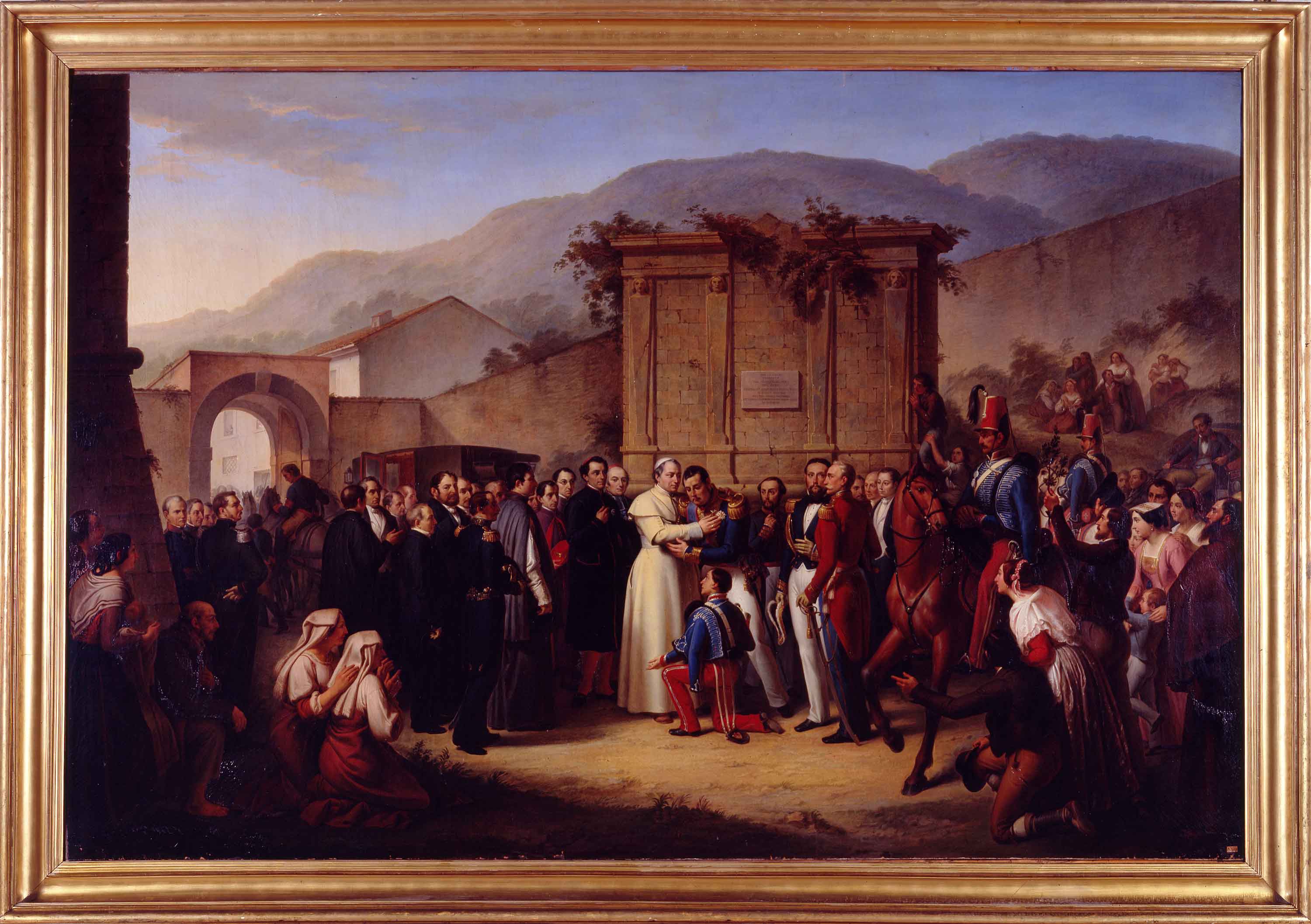
The Farewell of Pope Pius IX to Ferdinand II after the Neapolitan exile - Before Restoration
© 2026 Patrons of the Arts
in the Vatican Museums
Vatican Museums V-00120,
Vatican City State (Europe)
+39 0669864499