

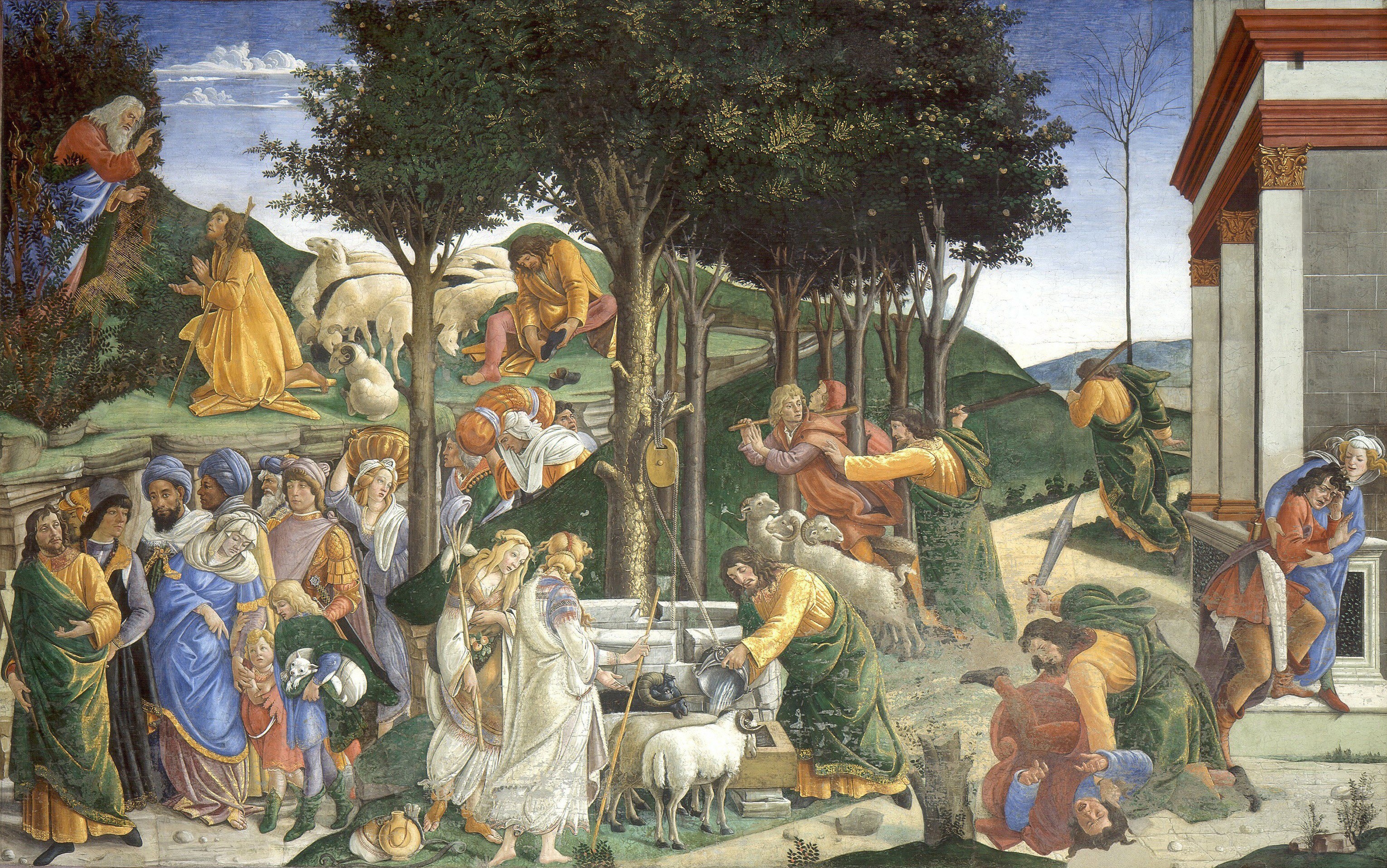
Events from the life of Moses
Artist: Sandro Botticelli
Date: 1481 - 1482
Classification: Fresco
Dimensions: 348,5 × 558 cm
Adopted By: The Michigan Chapter
Description
The Sistine Chapel occupies a building situated at the southwest corner of the old medieval core of the Apostolic Palace. It is named after Pope Sixtus IV della Rovere, for whom it was built between 1477 and 1480. At present, the entrance to the chapel is through a small door in the wall behind the altar, approached either by descending the stairs from Raphael’s Stanze, or by ascending from the rooms of the Collection of Modern Religious Art. The official entrance to the chapel, by contrast, is through the Sala Regia, the large audience hall (aula magna) where the pope publicly received royal and imperial ambassadors. The chapel stands on the site of an earlier chapel, probably of the 13th century, perhaps of the time of Nicholas III, of which only a few fugitive references are found in the documents. Rebuilt by Giovannino de’ Dolci on a plan designed (according to Vasari) by the Florentine architect Baccio Pontelli, the Sistine Chapel was intended to fulfill a dual purpose: religious and defensive. It was to house the new palatine chapel and fortify the Apostolic Palace. The defensive nature of the building is evident from its austere and massive exterior, and the machicolations on top (visible from the Sala Sobieski, from the covered passageway linking it with the Stanza dell’Incendio in Raphael’s Stanze and from the Sala degli Indirizzi in the Vatican Library on the lower floor). The building includes a basement, a mezzanine floor, and the chapel itself, above which is a spacious attic with a galleried sentry walk for the guards on the outside. The mezzanine, which now houses part of the Collection of Modern Religious Art, was once occupied by the offices of the Magistri Caeremaniarum (masters of ceremonies, who also had secretarial tasks); they included the German Johann Burchard, who lived in the time of Alexander VI, Paris de Grassi's, a contemporary of Julius II and Leo X, and Biagio da Cesena, a contemporary of Paul III. The chapel is still used for some pontifical masses and conclaves for the election of a new pope, formerly held in the nearby Chapel of the Holy Sacrament, frescoed by Fra Angelico, but demolished to extend the ceremonial staircase (Scala del Maresciallo) under Paul III and replaced by the Pauline Chapel. The Sistine Chapel is built on a very simple rectangular plan. It has no apse and is 40.23 m long, 13.41 m wide, and 20.7 m high. It is covered with a flattened barrel vault, with weight-relieving spandrels descending over the twelve round-arched windows of the upper story. The floor is in inlaid polychrome marbles. A marble screen with upper grating, a free interpretation of the Byzantine iconostasis, separates the area of the presbytery reserved for the officiating clergy from that of the congregation. It was originally joined to the singing gallery (cantoria), but was moved back in the 16th century to enlarge the presbytery. Both the screen and the singing gallery are ornamented with extremely delicate marble reliefs.The walls were frescoed with scenes from the lives of Moses and Christ, and with full-length portraits of popes, by a team of painters originally composed of Perugino, Sandro Botticelli, Domenico Ghirlandaio, and Cosimo Rosselli, assisted by members of their respective workshops, among whom were Piero di Cosimo, Bartolomeo Della Gatta, and Luca Signorelli: these latter executed the last two frescoes of the Mosaic series. Pier Matteo d’Amelia painted a simple, star-spangled sky on the vault. The work was begun in 1481 and completed in 1482. On 15 August 1483, Sixtus IV consecrated the new chapel, dedicating it to the Virgin Mary. Perugino had painted the lost altarpiece of the Assumption of Mary and the first two panels of the scenes from the lives of Moses and Christ, later destroyed by Michelangelo to make room for the Last Judgement. The only signature that has been found in the frescoes is that of Perugino. The three popes who succeeded Sixtus IV left the chapel as they had found it. It was only in 1506 that Julius II della Rovere, nephew of Sixtus IV, decided to revamp the vault decoration. In 1508 he entrusted the task to Michelangelo Buonarroti, who tried in vain to resist the Pope’s will. Tradition has it that it was Donato Bramante, envious of his rival’s success (and certain he would fail), who suggested that Michelangelo be commissioned to do the job. On 10 May 1508, Michelangelo began work on the ceiling, initially with the help of assistants such as Jacopo d’Indaco and Francesco Granacci. But as soon as he had learned the fresco technique, entirely new to him at the time, he dismissed his assistants. By September 1510 he had finished half the vault (from the entrance to the Fall). On 14 August 1511, Julius, impatient to see the work, forced Michelangelo to remove the scaffolding. The ceiling was completed in October 1512, and on All Saints’ Day (1 November) Julius II inaugurated it with a solemn high mass. Towards the end of 1533, Clement VII de’ Medici commissioned Michelangelo to make further changes to the decoration of the Sistine Chapel, especially by painting the Last Judgement. The placing of the Last Judgement over the altar is unusual; for liturgical reasons, it was traditionally depicted on the entrance wall. Once again, Michelangelo reluctantly accepted the commission, though he did not begin work on the painting until 1535, and only then under pressure from Paul III, Clement VII’s successor. The first step was to destroy the 15th-century paintings on the entrance wall, which was refaced by a slightly sloping layer of bricks (to stop dust was settling). Unaided by assistants, Michelangelo began to paint on this surface in the summer of 1536, completing the immense painting (which occupies 200 square meters and represents 391 figures) in the autumn of 1541. On 31 October of the same year, Paul Ill, who had followed the artist’s progress with great impatience, celebrated solemn vespers in front of this extraordinary painting which, according to Giorgio Vasari, aroused “the wonder and astonishment of the whole of Rome”.
South wall: Events from the life of Moses. Right to left: Moses kills the Egyptian who had maltreated an Israelite; he escapes from Egypt; he defends Jethro’s daughters from the shepherds, and helps the girls to water the flock; he takes off his shoes and prostrates himself before the burning bush (the inscription refers to this episode); he leads the Israelites out of Egypt. The fresco is by Botticelli. The popes are Sixtus I and Hyginus.
Detail
Adopted By:
The Michigan ChapterArtist: Sandro Botticelli
Date: 1481 - 1482
Provenience: Sistine Chapel
Dimensions: 348,5 × 558 cm
Department:
XV-XVI Century ArtCurators:
Dr. Fabrizio Biferalimuseum:
Sistine ChapelLaboratories:
Painting & Wood
Events from the life of Moses
Details
Adopted by: The Michigan Chapter
Artist: Sandro Botticelli
Date: 1481 - 1482
Provenience: Sistine Chapel
Classification: Fresco
Dimensions: 348,5 × 558 cm
Museum: Sistine Chapel
Department: XV-XVI Century Art
Laboratory: Painting & Wood
Description
The Sistine Chapel occupies a building situated at the southwest corner of the old medieval core of the Apostolic Palace. It is named after Pope Sixtus IV della Rovere, for whom it was built between 1477 and 1480. At present, the entrance to the chapel is through a small door in the wall behind the altar, approached either by descending the stairs from Raphael’s Stanze, or by ascending from the rooms of the Collection of Modern Religious Art. The official entrance to the chapel, by contrast, is through the Sala Regia, the large audience hall (aula magna) where the pope publicly received royal and imperial ambassadors. The chapel stands on the site of an earlier chapel, probably of the 13th century, perhaps of the time of Nicholas III, of which only a few fugitive references are found in the documents. Rebuilt by Giovannino de’ Dolci on a plan designed (according to Vasari) by the Florentine architect Baccio Pontelli, the Sistine Chapel was intended to fulfill a dual purpose: religious and defensive. It was to house the new palatine chapel and fortify the Apostolic Palace. The defensive nature of the building is evident from its austere and massive exterior, and the machicolations on top (visible from the Sala Sobieski, from the covered passageway linking it with the Stanza dell’Incendio in Raphael’s Stanze and from the Sala degli Indirizzi in the Vatican Library on the lower floor). The building includes a basement, a mezzanine floor, and the chapel itself, above which is a spacious attic with a galleried sentry walk for the guards on the outside. The mezzanine, which now houses part of the Collection of Modern Religious Art, was once occupied by the offices of the Magistri Caeremaniarum (masters of ceremonies, who also had secretarial tasks); they included the German Johann Burchard, who lived in the time of Alexander VI, Paris de Grassi's, a contemporary of Julius II and Leo X, and Biagio da Cesena, a contemporary of Paul III. The chapel is still used for some pontifical masses and conclaves for the election of a new pope, formerly held in the nearby Chapel of the Holy Sacrament, frescoed by Fra Angelico, but demolished to extend the ceremonial staircase (Scala del Maresciallo) under Paul III and replaced by the Pauline Chapel. The Sistine Chapel is built on a very simple rectangular plan. It has no apse and is 40.23 m long, 13.41 m wide, and 20.7 m high. It is covered with a flattened barrel vault, with weight-relieving spandrels descending over the twelve round-arched windows of the upper story. The floor is in inlaid polychrome marbles. A marble screen with upper grating, a free interpretation of the Byzantine iconostasis, separates the area of the presbytery reserved for the officiating clergy from that of the congregation. It was originally joined to the singing gallery (cantoria), but was moved back in the 16th century to enlarge the presbytery. Both the screen and the singing gallery are ornamented with extremely delicate marble reliefs.The walls were frescoed with scenes from the lives of Moses and Christ, and with full-length portraits of popes, by a team of painters originally composed of Perugino, Sandro Botticelli, Domenico Ghirlandaio, and Cosimo Rosselli, assisted by members of their respective workshops, among whom were Piero di Cosimo, Bartolomeo Della Gatta, and Luca Signorelli: these latter executed the last two frescoes of the Mosaic series. Pier Matteo d’Amelia painted a simple, star-spangled sky on the vault. The work was begun in 1481 and completed in 1482. On 15 August 1483, Sixtus IV consecrated the new chapel, dedicating it to the Virgin Mary. Perugino had painted the lost altarpiece of the Assumption of Mary and the first two panels of the scenes from the lives of Moses and Christ, later destroyed by Michelangelo to make room for the Last Judgement. The only signature that has been found in the frescoes is that of Perugino. The three popes who succeeded Sixtus IV left the chapel as they had found it. It was only in 1506 that Julius II della Rovere, nephew of Sixtus IV, decided to revamp the vault decoration. In 1508 he entrusted the task to Michelangelo Buonarroti, who tried in vain to resist the Pope’s will. Tradition has it that it was Donato Bramante, envious of his rival’s success (and certain he would fail), who suggested that Michelangelo be commissioned to do the job. On 10 May 1508, Michelangelo began work on the ceiling, initially with the help of assistants such as Jacopo d’Indaco and Francesco Granacci. But as soon as he had learned the fresco technique, entirely new to him at the time, he dismissed his assistants. By September 1510 he had finished half the vault (from the entrance to the Fall). On 14 August 1511, Julius, impatient to see the work, forced Michelangelo to remove the scaffolding. The ceiling was completed in October 1512, and on All Saints’ Day (1 November) Julius II inaugurated it with a solemn high mass. Towards the end of 1533, Clement VII de’ Medici commissioned Michelangelo to make further changes to the decoration of the Sistine Chapel, especially by painting the Last Judgement. The placing of the Last Judgement over the altar is unusual; for liturgical reasons, it was traditionally depicted on the entrance wall. Once again, Michelangelo reluctantly accepted the commission, though he did not begin work on the painting until 1535, and only then under pressure from Paul III, Clement VII’s successor. The first step was to destroy the 15th-century paintings on the entrance wall, which was refaced by a slightly sloping layer of bricks (to stop dust was settling). Unaided by assistants, Michelangelo began to paint on this surface in the summer of 1536, completing the immense painting (which occupies 200 square meters and represents 391 figures) in the autumn of 1541. On 31 October of the same year, Paul Ill, who had followed the artist’s progress with great impatience, celebrated solemn vespers in front of this extraordinary painting which, according to Giorgio Vasari, aroused “the wonder and astonishment of the whole of Rome”.
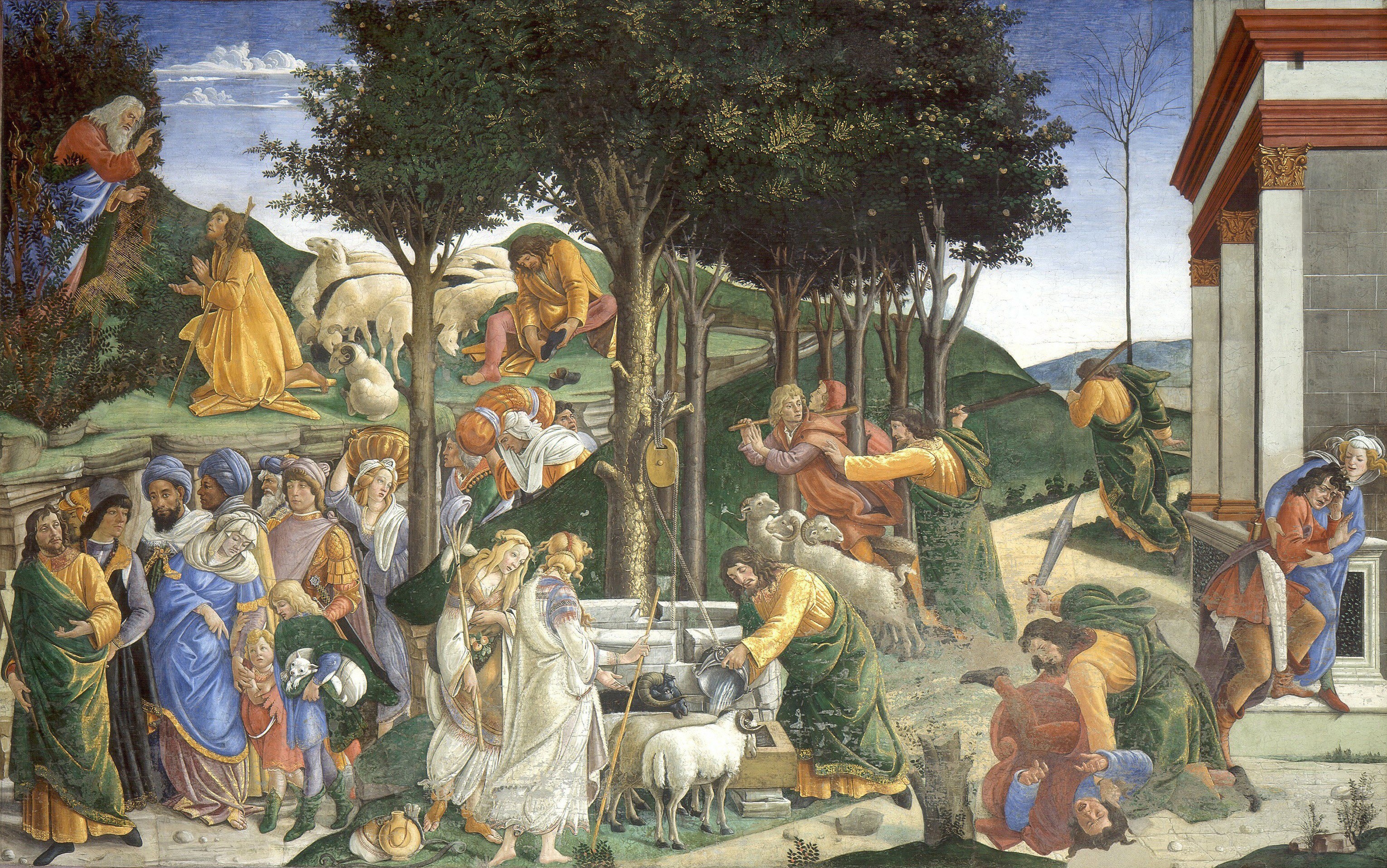
South wall: Events from the life of Moses. Right to left: Moses kills the Egyptian who had maltreated an Israelite; he escapes from Egypt; he defends Jethro’s daughters from the shepherds, and helps the girls to water the flock; he takes off his shoes and prostrates himself before the burning bush (the inscription refers to this episode); he leads the Israelites out of Egypt. The fresco is by Botticelli. The popes are Sixtus I and Hyginus.
Media
The Trials of Moses
© 2026 Patrons of the Arts
in the Vatican Museums
Vatican Museums V-00120,
Vatican City State (Europe)
+39 0669864499