

Sandstone Sarcophagus Lid
Artist: Unknown
Date: 712 - 30 B.C.
Classification: Sarcophagus Lid
Dimensions: 207 x 54 x 31 cm
Materials: Painted sandstone
Adopted By: The Northwest Chapter
Total Cost: € 22,000
Description
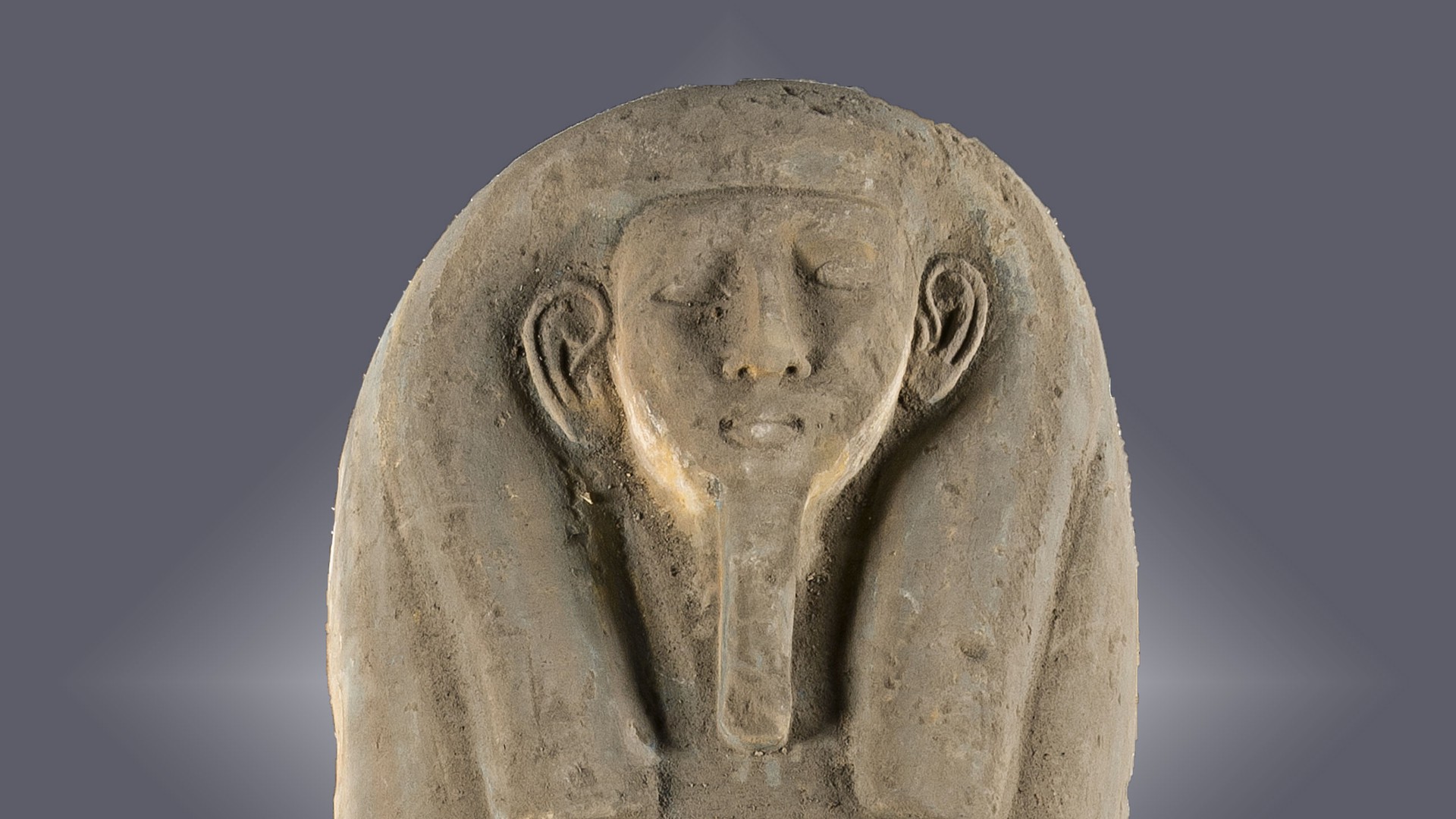
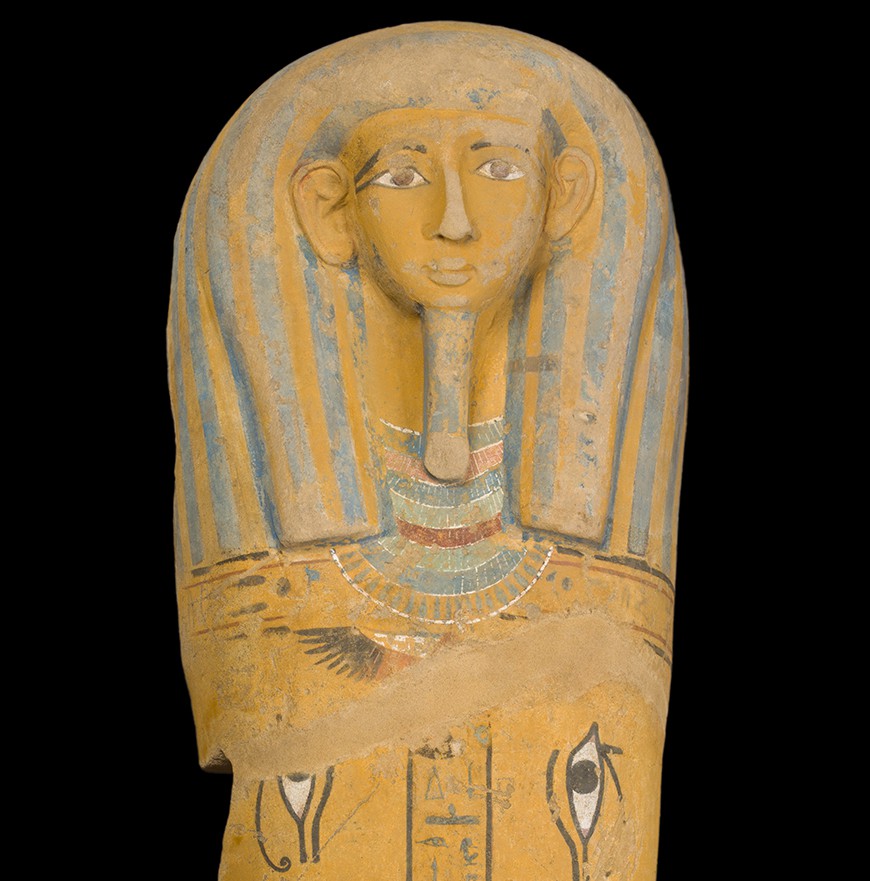
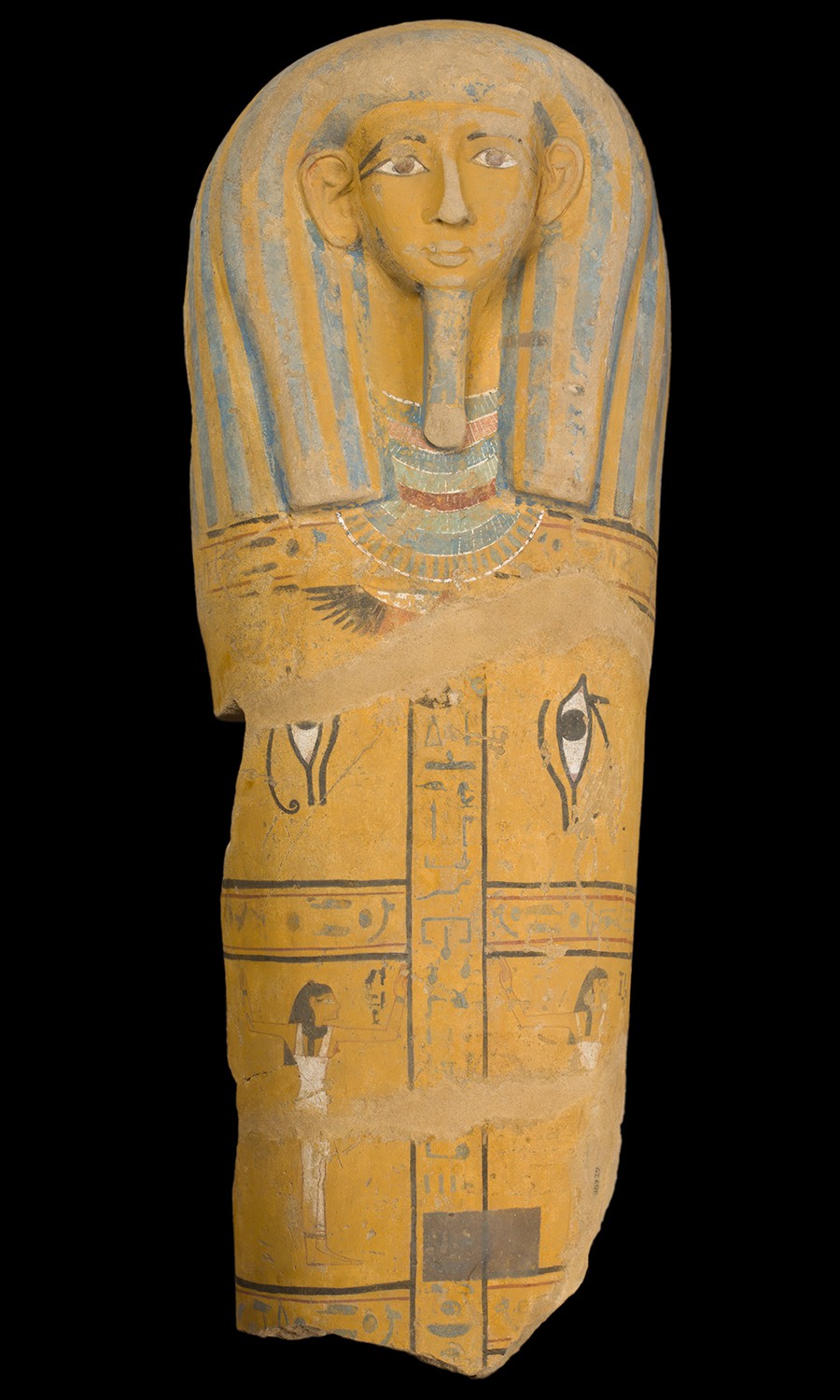
The beautiful yellow, fine-grain sandstone sarcophagus cover is painted on the external surface with multiple colors over a yellow background. A large yellow and blue striped hat exposes only the face and ears framing the face with a false beard, a symbol of regeneration. A necklace consisting of a series of rows adorns the chest of the figure.
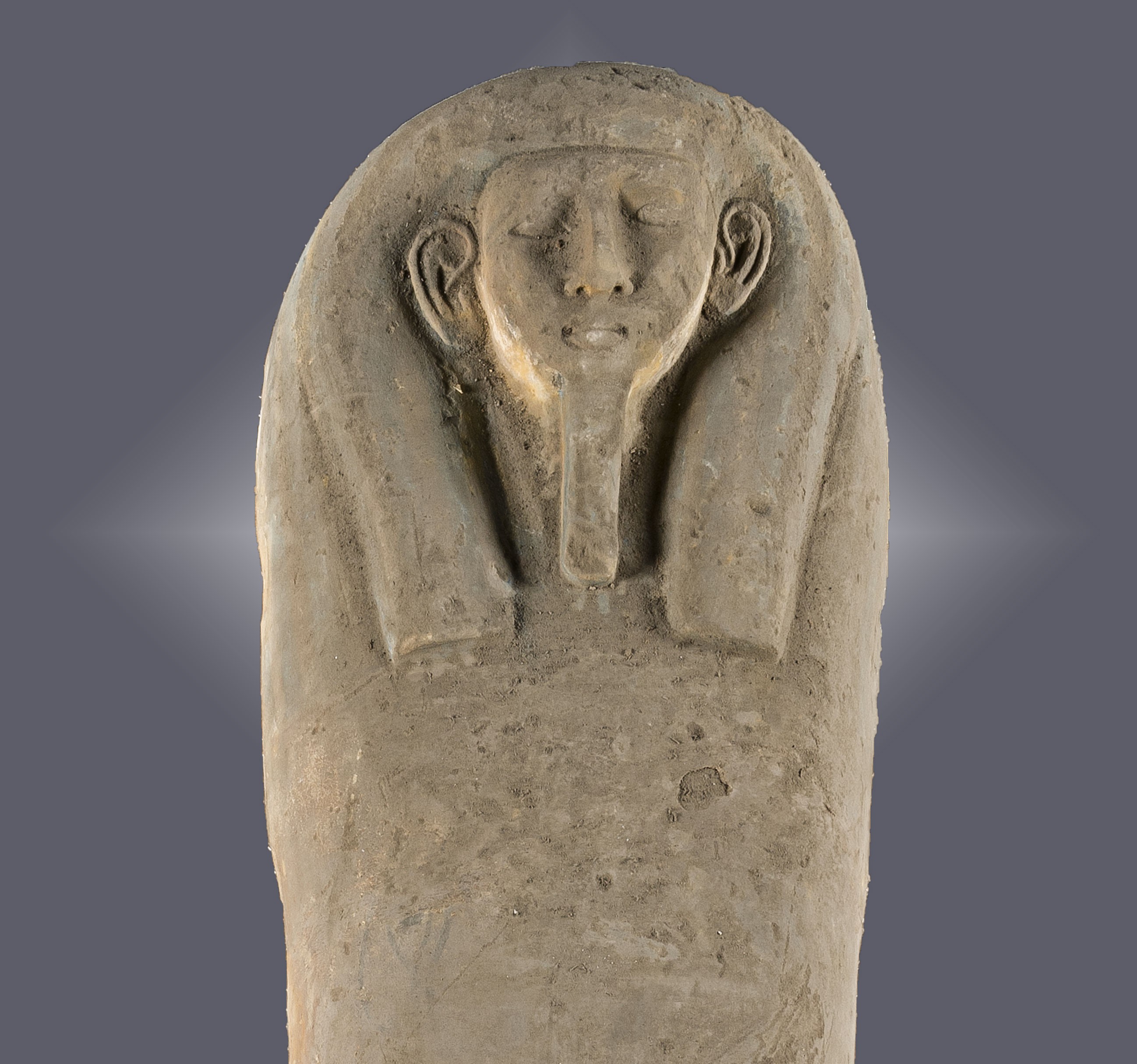
The thick layer of dust currently present does not permit a correct reading of the artifact, yet it presents rich decorations: a long vertical hieroglyphic inscription, today barely legible, running along the body; on the two sides are three panes with divine figures, delimited by a band of hieroglyphic inscriptions. This is an important object of the collection because there are very few specimens of sandstone sarcophagi in existence. Those extant are usually made of stone or wood. This sarcophagus was removed from the exhibition for conservation reasons.
State of Preservation
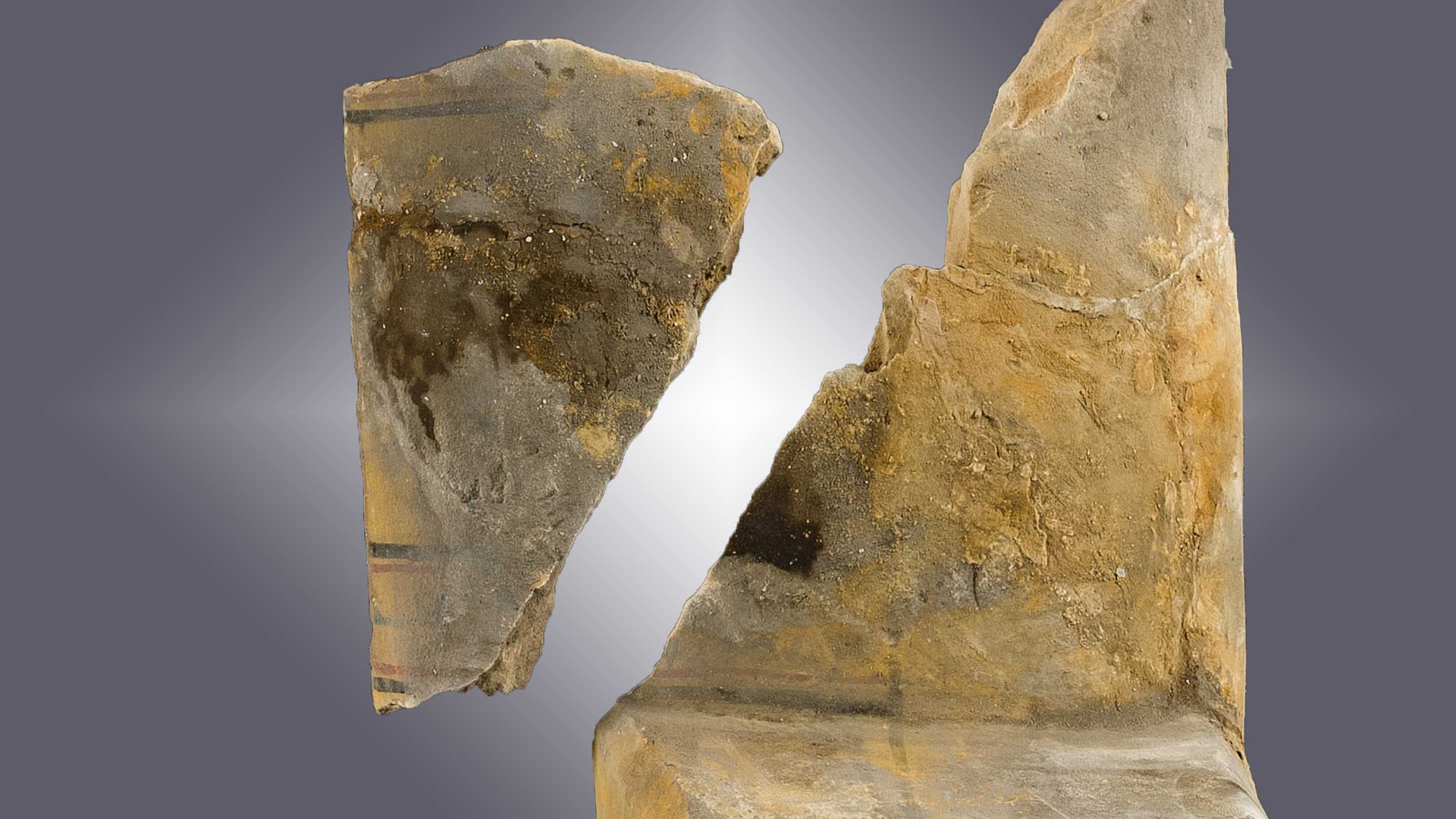
The cover was completely covered by a thick layer of dirt and dust that hid a large part of the polychrome stone on the surface. The surface was affected by a serious phenomenon of scaling on the pictorial decorations and the substrate, almost certainly caused by the presence of the fluorescence of soluble salts. This phenomenon was particularly evident in the fractured and detached area of the lid in direct contact with the floor.
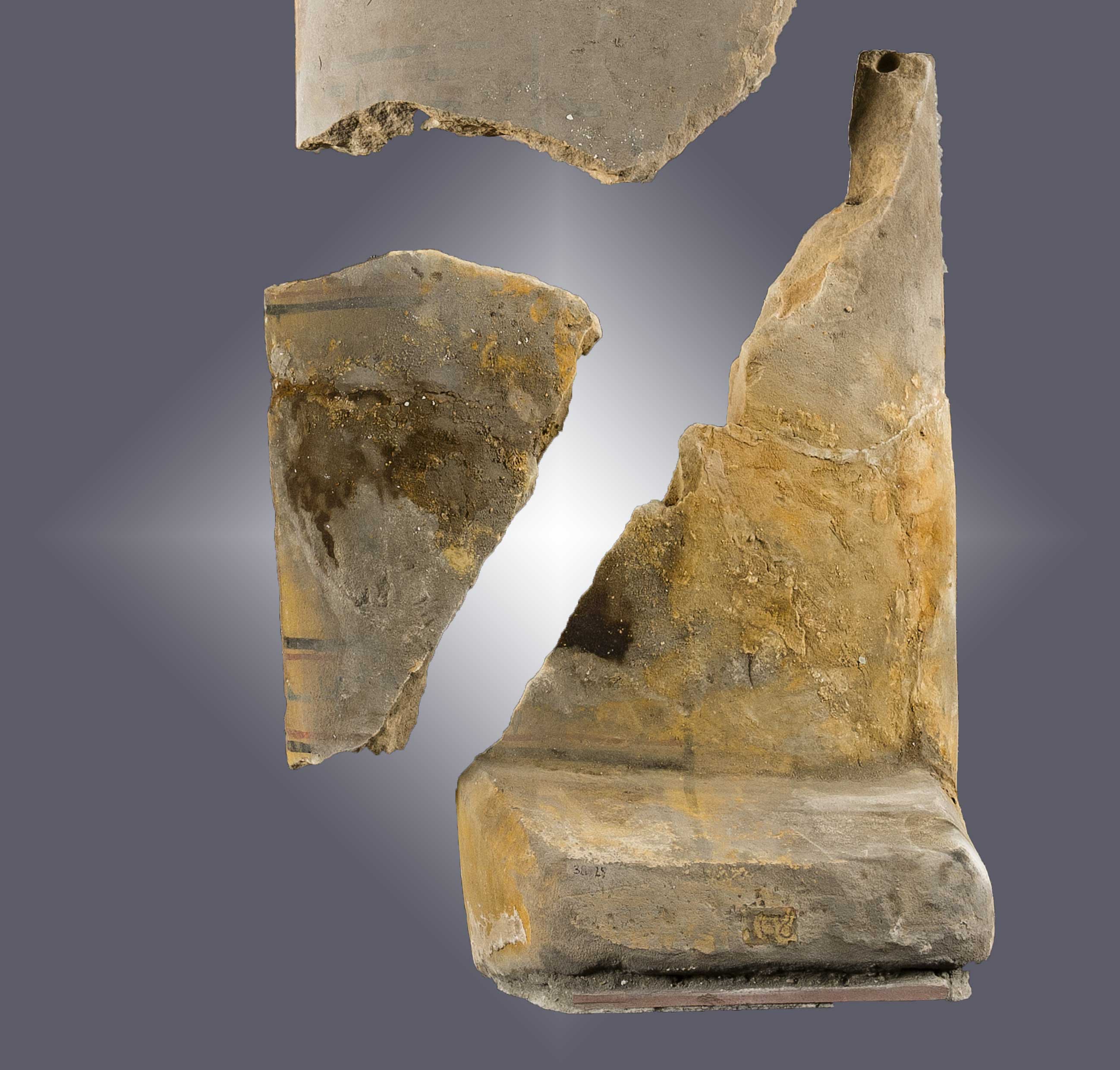
There were visible lesions and fractures on the stone, in particular, due to previous restorations and where the grouting was deteriorated or missing. Old anchor clamps made with oxidizing material were visible at the points of fracture on the cover.
Restoration Procedures
Regarding the restoration of this sarcophagus lid, there were various problems that arose during the conservation process and were closely linked to the structure of the stone support, the choice of techniques to be used, and the various levels of decay and deterioration. The restorers have carried out the appropriate and necessary steps in order to identify the specific methods of intervention needed and which are supported by extensive scientific analysis.
The restoration work has thus been characterized throughout its course by a close and fruitful collaboration between the different professionals involved: the art historian, the scientific expert and the conservator.
The main issues faced during the restoration were those related to:
- the operations of removal of the substances used during the maintenance and/or previous restorations;
- the consolidation of the stone support and the layers of paint;
- the grouting and reassembly of the fragmented parts of the piece, for its transfer and exhibit in the Vatican Museums.
Technical specifications of the different processes will be provided in the final report: here below is a brief description of what has been carried out to date.
- The surface substances have been removed using chemical materials. Restorers have conducted studies and research on various supporting substances to be used to maintain the suspended solvent mixtures and by testing specific products which are not found in normal commercial availability. The results were verified by comparing data from the microanalysis of induced fluorescence (polished sections, SEM-EDS, spettrofotometrie infrared, gas chromatography), and appropriately placed in summary tables.
- The surface substances have been removed using laser ablation. 37 analysis were performed with five different laser models, in order to identify the best method to match the different constituent pigments of the original paint layer, especially for blue and green Egyptian colors. The efficiency of these machines has been regularly verified by measurements performed with a “Power Portable” meter. For each analysis, graphically shown on a general mapping, restorers have reported parameters used in defining the characteristics of the ablation laser that has been used on a specific operating table, set up for the occasion in collaboration with the other colleagues in the Laboratory. The test of the results has been carried out by comparing data from colorimetric and microanalytical (polished sections) investigations.
- The cohesion defects of the sandstone support were solved. Laboratory tests were executed on sandstone blocks in order to verify the effectiveness of four different consolidating products. Based on the obtained results, all borders and sections of unpainted decoration of the lid have been consolidated through repeated applications of nano-silica in different concentrations. The results were then verified through microanalytical surveys (petrography, SEM-EDS, mineralogical analysis).
- The cohesion defects of the paint layer have been repaired. Based on the results obtained from specific colorimetric investigations, restorers have repeatedly applied a suitable consolidation product (Jan Funori) by spraying it with a spray gun. The restorers then proceeded using injections of a mixture of polymer, vinilbutirrate and nanosilica, after the consolidation of the interfaces by injections of nanosilica.
- Plastering. Different binding agents were tested in order to identify the most suitable product in order to create plaster similar in color and weight to the original stone and which are easily reversible. The final binding agent consists of a mixture of acrylic resin in solution and nanosilica.
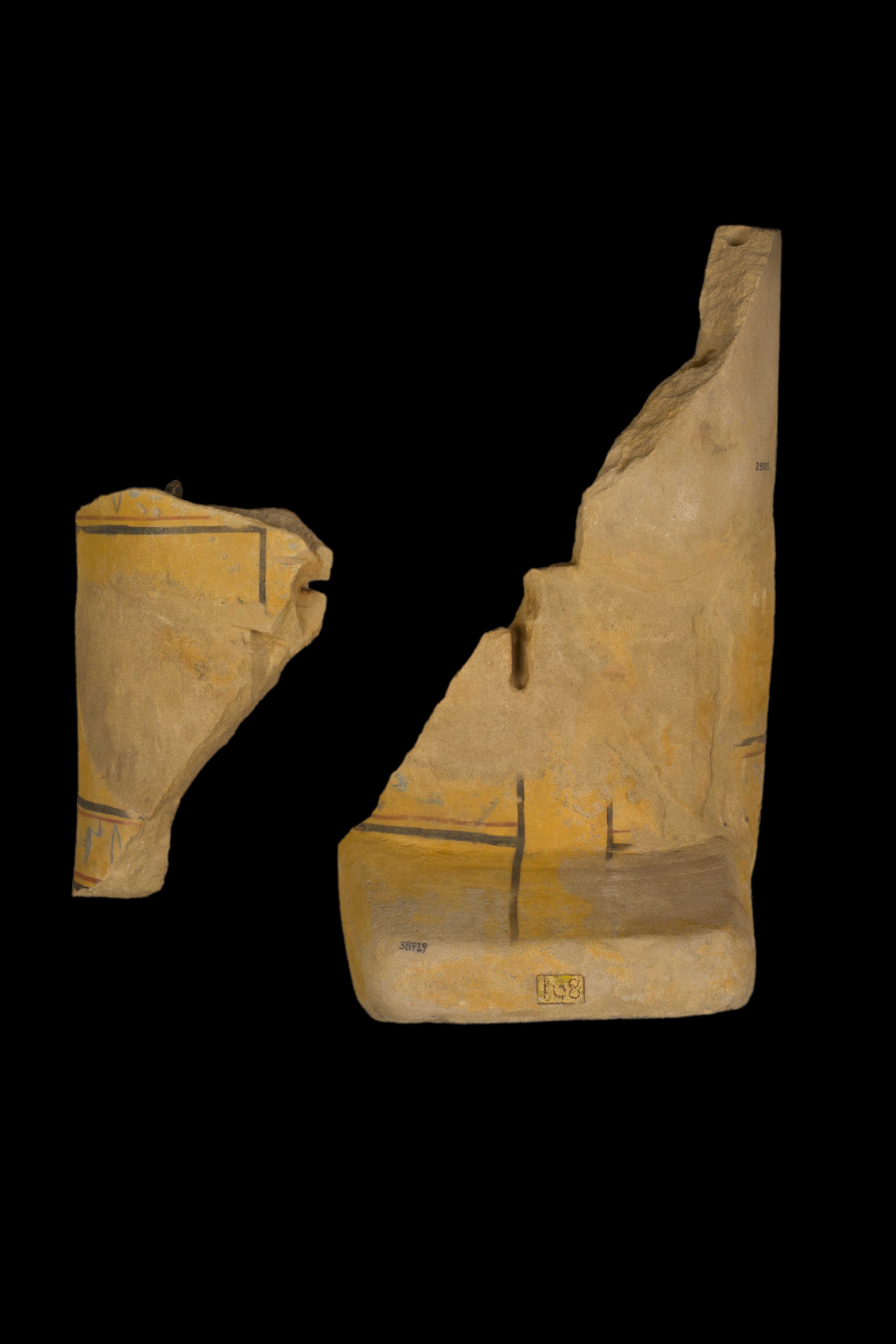
- Assembly of parts. Since it was necessary to assemble together the three sections into which the lid is subdivided, restorers considered it appropriate to design a system of assembly and support using 3D scanning and thus constructing a perimeter frame, which allows the handling and exhibit of the work within the Museums. This process is still a work in progress.
In addition, the Egyptian sarcophagus lid has been the subject of two discussions during last APLAR 5 Congress, on the use of laser ablation in the preservation of cultural heritage, which took place last September at the Vatican Museums. Two articles on this restoration project will be published in the Acts of the aforementioned conference and in the next Bulletin of the Vatican Museums. It is clear that the initial conservation project has been modified during the course of its work, involving additional operational modes, studies and research. This also means that there have been necessary time delays for the work but which also have allowed the emergency of results otherwise unattainable using more traditional methodologies.
Detail
Adopted By:
The Northwest ChapterInventory N°: 25065
Artist: Unknown
Date: 712 - 30 B.C.
Provenience: Egypt
Dimensions: 207 x 54 x 31 cm
Materials: Painted sandstone
Department:
Egyptian and Near Eastern AntiquitiesCurators:
Dr. Alessia Amentamuseum:
Gregorian Egyptian MuseumLaboratories:
Stone MaterialsWishbook year: 2011
Total Cost
€ 22,000
Sandstone Sarcophagus Lid - Before & After Restoration

Sandstone Sarcophagus Lid
Details
Adopted by: The Northwest Chapter
Inventory: 25065
Artist: Unknown
Date: 712 - 30 B.C.
Provenience: Egypt
Classification: Sarcophagus Lid
Materials: Painted sandstone
Dimensions: 207 x 54 x 31 cm
Museum: Gregorian Egyptian Museum
Department: Egyptian and Near Eastern Antiquities
Laboratory: Stone Materials
Wishbook year: 2011
Description
The beautiful yellow, fine-grain sandstone sarcophagus cover is painted on the external surface with multiple colors over a yellow background. A large yellow and blue striped hat exposes only the face and ears framing the face with a false beard, a symbol of regeneration. A necklace consisting of a series of rows adorns the chest of the figure.
The thick layer of dust currently present does not permit a correct reading of the artifact, yet it presents rich decorations: a long vertical hieroglyphic inscription, today barely legible, running along the body; on the two sides are three panes with divine figures, delimited by a band of hieroglyphic inscriptions. This is an important object of the collection because there are very few specimens of sandstone sarcophagi in existence. Those extant are usually made of stone or wood. This sarcophagus was removed from the exhibition for conservation reasons.
State of Preservation
The cover was completely covered by a thick layer of dirt and dust that hid a large part of the polychrome stone on the surface. The surface was affected by a serious phenomenon of scaling on the pictorial decorations and the substrate, almost certainly caused by the presence of the fluorescence of soluble salts. This phenomenon was particularly evident in the fractured and detached area of the lid in direct contact with the floor.
There were visible lesions and fractures on the stone, in particular, due to previous restorations and where the grouting was deteriorated or missing. Old anchor clamps made with oxidizing material were visible at the points of fracture on the cover.
Restoration Procedures
Regarding the restoration of this sarcophagus lid, there were various problems that arose during the conservation process and were closely linked to the structure of the stone support, the choice of techniques to be used, and the various levels of decay and deterioration. The restorers have carried out the appropriate and necessary steps in order to identify the specific methods of intervention needed and which are supported by extensive scientific analysis.
The restoration work has thus been characterized throughout its course by a close and fruitful collaboration between the different professionals involved: the art historian, the scientific expert and the conservator.
The main issues faced during the restoration were those related to:
- the operations of removal of the substances used during the maintenance and/or previous restorations;
- the consolidation of the stone support and the layers of paint;
- the grouting and reassembly of the fragmented parts of the piece, for its transfer and exhibit in the Vatican Museums.
Technical specifications of the different processes will be provided in the final report: here below is a brief description of what has been carried out to date.
- The surface substances have been removed using chemical materials. Restorers have conducted studies and research on various supporting substances to be used to maintain the suspended solvent mixtures and by testing specific products which are not found in normal commercial availability. The results were verified by comparing data from the microanalysis of induced fluorescence (polished sections, SEM-EDS, spettrofotometrie infrared, gas chromatography), and appropriately placed in summary tables.
- The surface substances have been removed using laser ablation. 37 analysis were performed with five different laser models, in order to identify the best method to match the different constituent pigments of the original paint layer, especially for blue and green Egyptian colors. The efficiency of these machines has been regularly verified by measurements performed with a “Power Portable” meter. For each analysis, graphically shown on a general mapping, restorers have reported parameters used in defining the characteristics of the ablation laser that has been used on a specific operating table, set up for the occasion in collaboration with the other colleagues in the Laboratory. The test of the results has been carried out by comparing data from colorimetric and microanalytical (polished sections) investigations.
- The cohesion defects of the sandstone support were solved. Laboratory tests were executed on sandstone blocks in order to verify the effectiveness of four different consolidating products. Based on the obtained results, all borders and sections of unpainted decoration of the lid have been consolidated through repeated applications of nano-silica in different concentrations. The results were then verified through microanalytical surveys (petrography, SEM-EDS, mineralogical analysis).
- The cohesion defects of the paint layer have been repaired. Based on the results obtained from specific colorimetric investigations, restorers have repeatedly applied a suitable consolidation product (Jan Funori) by spraying it with a spray gun. The restorers then proceeded using injections of a mixture of polymer, vinilbutirrate and nanosilica, after the consolidation of the interfaces by injections of nanosilica.
- Plastering. Different binding agents were tested in order to identify the most suitable product in order to create plaster similar in color and weight to the original stone and which are easily reversible. The final binding agent consists of a mixture of acrylic resin in solution and nanosilica.
- Assembly of parts. Since it was necessary to assemble together the three sections into which the lid is subdivided, restorers considered it appropriate to design a system of assembly and support using 3D scanning and thus constructing a perimeter frame, which allows the handling and exhibit of the work within the Museums. This process is still a work in progress.
In addition, the Egyptian sarcophagus lid has been the subject of two discussions during last APLAR 5 Congress, on the use of laser ablation in the preservation of cultural heritage, which took place last September at the Vatican Museums. Two articles on this restoration project will be published in the Acts of the aforementioned conference and in the next Bulletin of the Vatican Museums. It is clear that the initial conservation project has been modified during the course of its work, involving additional operational modes, studies and research. This also means that there have been necessary time delays for the work but which also have allowed the emergency of results otherwise unattainable using more traditional methodologies.
Media
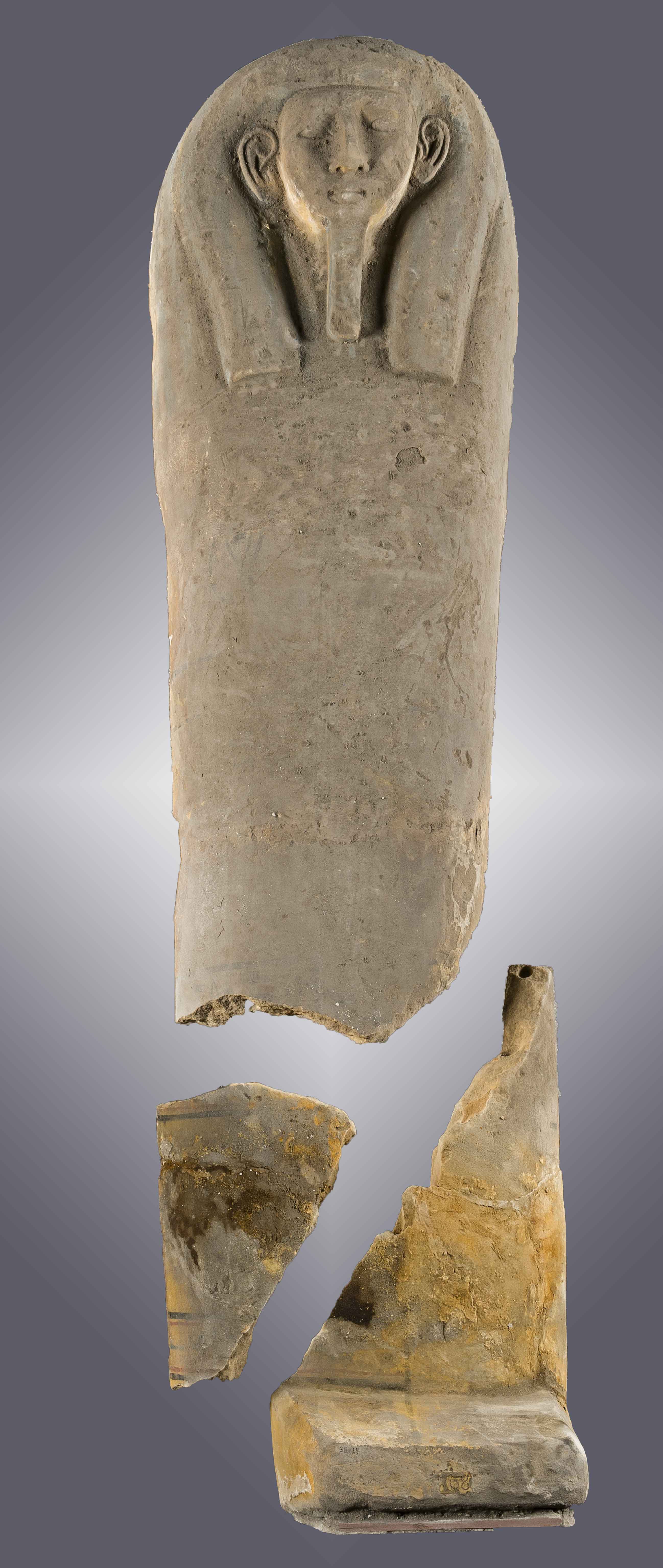
Sandstone Sarcophagus Lid - Before Restoration
Sandstone Sarcophagus Lid - After Restoration
Sandstone Sarcophagus Lid - Lower Section After Restoration
Restorations Update: Sandstone Sarcophagus Lid - Before & After Restoration
© 2026 Patrons of the Arts
in the Vatican Museums
Vatican Museums V-00120,
Vatican City State (Europe)
+39 0669864499