

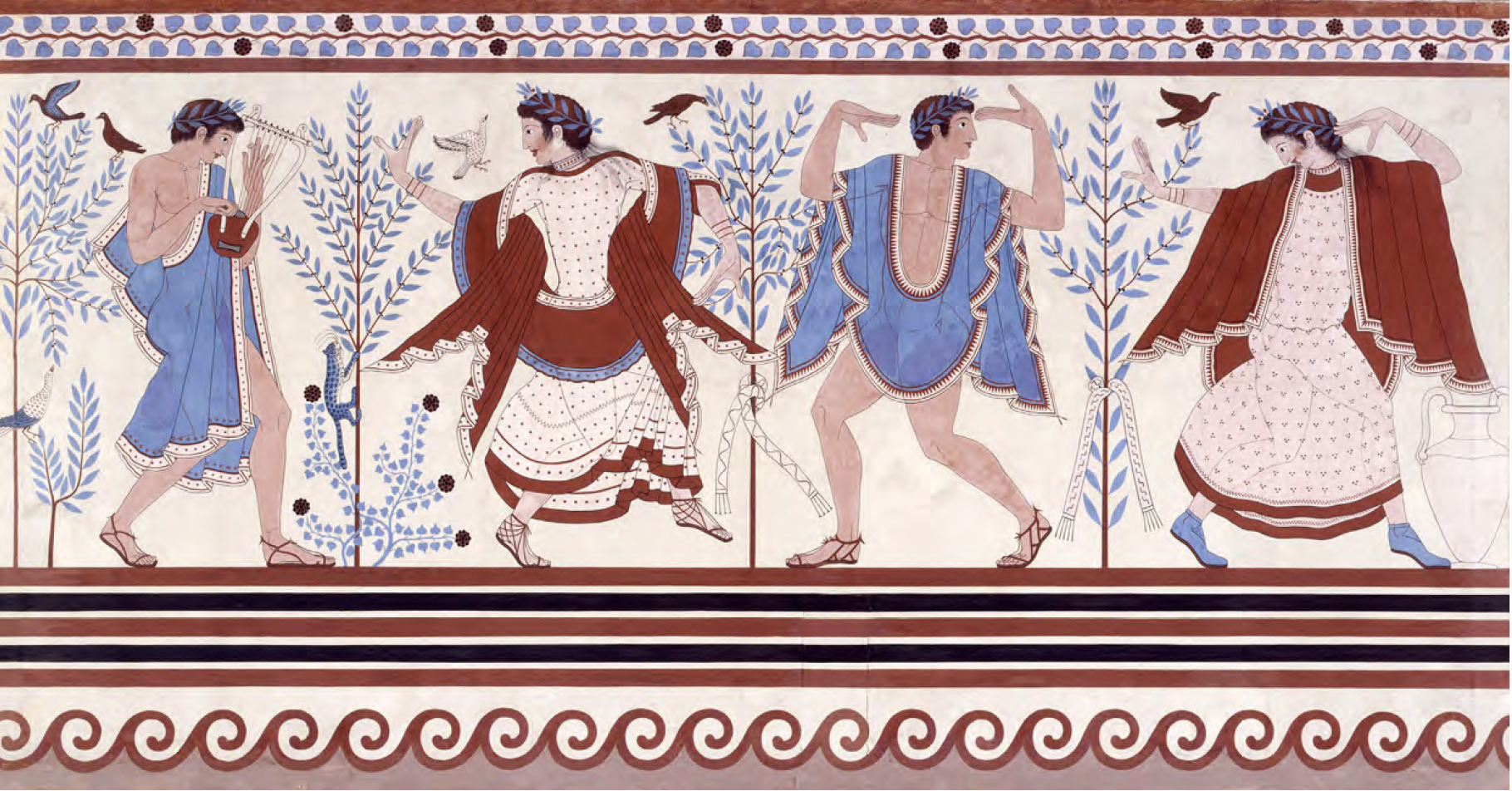
Life-Size Copies of the Pictorial Cycle of the Tomb of the Triclinium
Artist: Carlo Ruspi
Date: 1860; copied from the original paintings dated 470 B.C.
Dimensions: 220 x 112 cm (inv. number 14721); 170 x 325 cm (inv. number 14715)
Materials: Tempera on paper lined with paper and silk mounted on an extensible frame
Description
NORMAL PRIORITY PROJECT
The Triclinium tomb, located in the Monterozzi necropolis in Tarquinia, was discovered in 1830, intact with its paintings still in place. The first drawings of the tomb were made by archaeological artist Carlo Ruspi in 1831, one year after its discovery. The following year, he conceived the idea of reproducing the entire cycle as a full-scale facsimile, performing a trial limited to two figures: the ecstatic dancer and the auleta on the right wall. After receiving a commission from the Pontifical Government’s Commission of Antiquities and Fine Arts, Ruspi delivered the first complete facsimile of an Etruscan tomb ever made to the Vatican Museums in December 1833. It was displayed in the Gregorian Etruscan Museum, which opened shortly thereafter in 1837. In 1834, King Ludwig I of Bavaria immediately commissioned a second facsimile from the artist for the royal collection of ancient vases in Munich. After the Munich copies were lost during World War II, the Vatican series became the only complete reproduction made at the time of the excavation, when the newly discovered paintings were still intact. It is therefore a document of exceptional importance in understanding the original pictorial cycle, which has suffered the ravages of time. The original paintings date to 470 BC; for conservation reasons, they were detached from the tomb’s walls in 1949 and are now on display at the National Archaeological Museum in Tarquinia.
Total Cost: € 74.407,00 ($ 87,547.28)
State of Preservation
The pieces restored in the 1980s are currently showing signs of deterioration due to the aluminum expansion frame used during the previous restoration. The panels are in a poor state of preservation. Coherent and inconsistent particulate matter is present, as well as stains of varying nature and extent. The silk veil used for the lining during the previous restoration is partially detached, and there are tears and lacunae in the paper support. The pigments are dusty, and there are abrasions, lifting, and decohesion of the pictorial layer.
Restoration Procedures
- Detaching the artworks from the Rigamonti frame by removing the metal butterflies
- Dry cleaning using soft-bristle brushes, natural and synthetic latex sponges, and a micro- aspirator with HEPA filters and adjustable suction power
- Fixing the pictorial layer with Funori in a 1–2% aqueous or hydro alcoholic solution
- Dry detachment of the lining silk applied during the previous restoration.
- Detaching the lining paper applied during the previous restoration with Movilith DMC 2, where possible, especially in areas where the support is torn and the flaps are spaced
- Checking and reviewing previous restorations to assess their functionality
- Reintegration of gaps and tears using ply and Japanese paper of the correct thickness, color, and pulp. Use an adhesive with cellulose ethers and/or starch
- Color adjustment with tempera
- Fabrication of perimeter flaps
- Japanese paper of adequate thickness
- Perimeter adhesion of the work to a 1.3 cm-thick honeycomb cardboard panel at the Japanese paper flaps.
- Mounting the piece within a frame using a maple wood rod and museum polycarbonate.
Detail
Inventory N°: 14715, 14721
Artist: Carlo Ruspi
Date: 1860; copied from the original paintings dated 470 B.C.
Dimensions: 220 x 112 cm (inv. number 14721); 170 x 325 cm (inv. number 14715)
Materials: Tempera on paper lined with paper and silk mounted on an extensible frame
Department:
Greek and Roman AntiquitiesLaboratories:
PaperWishbook year: 2026

Life-Size Copies of the Pictorial Cycle of the Tomb of the Triclinium
Details
Inventory: 14715, 14721
Artist: Carlo Ruspi
Date: 1860; copied from the original paintings dated 470 B.C.
Materials: Tempera on paper lined with paper and silk mounted on an extensible frame
Dimensions: 220 x 112 cm (inv. number 14721); 170 x 325 cm (inv. number 14715)
Department: Greek and Roman Antiquities
Laboratory: Paper
Wishbook year: 2026
Description
NORMAL PRIORITY PROJECT
The Triclinium tomb, located in the Monterozzi necropolis in Tarquinia, was discovered in 1830, intact with its paintings still in place. The first drawings of the tomb were made by archaeological artist Carlo Ruspi in 1831, one year after its discovery. The following year, he conceived the idea of reproducing the entire cycle as a full-scale facsimile, performing a trial limited to two figures: the ecstatic dancer and the auleta on the right wall. After receiving a commission from the Pontifical Government’s Commission of Antiquities and Fine Arts, Ruspi delivered the first complete facsimile of an Etruscan tomb ever made to the Vatican Museums in December 1833. It was displayed in the Gregorian Etruscan Museum, which opened shortly thereafter in 1837. In 1834, King Ludwig I of Bavaria immediately commissioned a second facsimile from the artist for the royal collection of ancient vases in Munich. After the Munich copies were lost during World War II, the Vatican series became the only complete reproduction made at the time of the excavation, when the newly discovered paintings were still intact. It is therefore a document of exceptional importance in understanding the original pictorial cycle, which has suffered the ravages of time. The original paintings date to 470 BC; for conservation reasons, they were detached from the tomb’s walls in 1949 and are now on display at the National Archaeological Museum in Tarquinia.
Total Cost: € 74.407,00 ($ 87,547.28)
State of Preservation
The pieces restored in the 1980s are currently showing signs of deterioration due to the aluminum expansion frame used during the previous restoration. The panels are in a poor state of preservation. Coherent and inconsistent particulate matter is present, as well as stains of varying nature and extent. The silk veil used for the lining during the previous restoration is partially detached, and there are tears and lacunae in the paper support. The pigments are dusty, and there are abrasions, lifting, and decohesion of the pictorial layer.
Restoration Procedures
- Detaching the artworks from the Rigamonti frame by removing the metal butterflies
- Dry cleaning using soft-bristle brushes, natural and synthetic latex sponges, and a micro- aspirator with HEPA filters and adjustable suction power
- Fixing the pictorial layer with Funori in a 1–2% aqueous or hydro alcoholic solution
- Dry detachment of the lining silk applied during the previous restoration.
- Detaching the lining paper applied during the previous restoration with Movilith DMC 2, where possible, especially in areas where the support is torn and the flaps are spaced
- Checking and reviewing previous restorations to assess their functionality
- Reintegration of gaps and tears using ply and Japanese paper of the correct thickness, color, and pulp. Use an adhesive with cellulose ethers and/or starch
- Color adjustment with tempera
- Fabrication of perimeter flaps
- Japanese paper of adequate thickness
- Perimeter adhesion of the work to a 1.3 cm-thick honeycomb cardboard panel at the Japanese paper flaps.
- Mounting the piece within a frame using a maple wood rod and museum polycarbonate.
© 2026 Patrons of the Arts
in the Vatican Museums
Vatican Museums V-00120,
Vatican City State (Europe)
+39 0669864499