

Equestrian Monument of Constantine
Artist: Gian Lorenzo Bernini
Date: 1654-1670
Classification: Statue
Dimensions: H 6.40 m; W 4.70 m; D 2.15 m (equestrian monument including base)
Materials: marble and stucco
Adopted By: The Italian & International Chapter, The Washington D.C. Chapter
Description
HIGH PRIORITY PROJECT
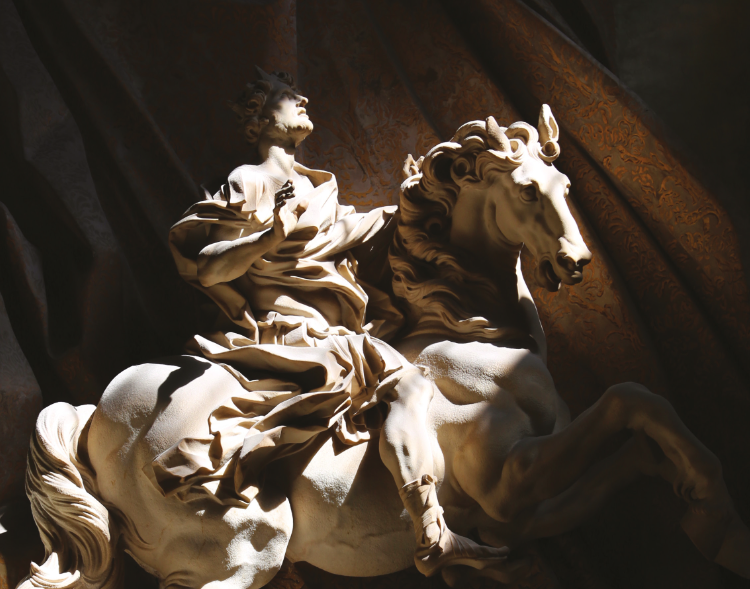
The monumental statue was commissioned by Pope Innocent X Pamphili (1644–1655) to Gian Lorenzo Bernini between 1654 and 1670. It depicts Emperor Constantine on horseback, dressed as a condottiere, at the moment he sees the miraculous vision of the Cross in the sky, bearing the words In hoc signo vinces (In this sign you will conquer). Carved from a single block of marble, the statue is placed in a niche adorned with magnificent, animated painted stucco drapery, a perfect example of the Baroque aesthetic, which blends sculpture, architecture and painting. Bernini was the eminent interpreter of this aesthetic. The monument is located on the route of the Scala Regia, the scenic staircase designed by Bernini to connect the Bronze Portal - the official entrance to the Vatican - to the Sala Regia of the Apostolic Palace. This strategic positioning ensured that, as visitors ascended to the state rooms, they were greeted by the powerful symbolic image of the triumph of Christ.
Total Cost: € 291.233,00 ( $ 342,664.75)
State of Preservation
There are widespread deposits of inconsistent and partially adherent particulate matter, chromatically altered layers of various kinds, reworked mortar and/or plaster, and grout. The basement has suffered significant degradation due to the acute yellowing of the surfaces caused by the alteration of superimposed substances. Fractures and cracks are also present. The base, parts of the stucco have fallen off the metal reinforcement, with a greater concentration in areas of overhang. There is widespread retouching on the surfaces, masking old damages and putty. Similarly, there is widespread repainting over the original tempera and gold leaf finish, with frequent dirt deposits, especially in the reliefs.
Restoration Procedures
Support (after consolidation and glazing of painted and gilded surfaces)
- Consolidation and restoration of adhesion for any detached fragments, using acrylic resins and stainless-steel reinforcing pins where necessary
- Restoration of adhesion defects between partially detached parts and the masonry support along cracks by injecting adhesives and inserting stainless steel pins where necessary. Removal of excess sealant and adhesives, debris and deposits from inside cracks and fractures, providing edge protection, sealing and propping up parts, preparing locations for pins.
Painted and gilded surfaces
Cleaning and removal of layers of foreign substances deposited on the original surface by mechanical action and/or with the aid of solutions of inorganic salts in suspension. Stuccoing to fill modelling gaps, cracks and fissures, followed by cleaning and chromatic revision of the edges, and eventual recasting of missing decorative parts. Pictorial reintegration of gaps, abrasions, or chromatic discontinuities in the finishing layers. This includes the patination of any reproductions using watercolours and superventilated powdered pigments according to the established criteria.
- Mapping the state of conservation and execution techniques, and interventions
- Conducting essays on the different phases of the intervention and the application of various materials and methodologies
- Providing assistance and coordination for the execution of the artefact survey and the final graphic restitution of the site mapping
- Assistance and coordination of photographic documentation
- Assistance and coordination in carrying out diagnostic and cognitive surveys
- Removal of inconsistent dry surface deposits using brushes and vacuum cleaners
- Removal of consistent surface deposits and soluble stains by thoroughly washing surfaces with soft brushes, sprayers, and sponges
- Removal of superimposed substances of various kinds, such as oils, varnishes, and waxes. This includes charges for assays to identify organic and/or inorganic solvents, suitable carriers, and application times, as well as the subsequent removal of dirt and solvent residues
- Detachment of fragments or unsafe parts of limited size, whose lack of adhesion poses a risk of collapse or makes it difficult to relocate them to the correct position
- Reattachment of flakes and fragments of limited weight and size using a suitable adhesive
- Mechanical and/or chemical removal of grout and/or reconstruction performed during previous interventions using materials whose composition may interact with the stone, or which have lost their conservation or aesthetic function
- Treatment to stop oxidation or to protect metal elements, such as pins, clamps, brackets, and hoops, that, due to their condition or location, cannot be removed or replaced
- Grouting with mortar in cases of cracks, fractures, and deficiencies
- Reconstructions with mortar of parts remade in previous interventions, if and where necessary
- Color revision to reduce the visual impact of grout, reconstructions, and the marble surface
- Protecting the surface with a suitable protective product
Detail
Adopted By:
The Italian & International Chapter The Washington D.C. ChapterPatrons:
Ed and Mary Hall (California Chapter) The International Patrons of the Arts in the Vatican Museums wish to thank Kayo Nishimoto, Charles and Lynn Zhang, Olessia Kantor
Artist: Gian Lorenzo Bernini
Date: 1654-1670
Dimensions: H 6.40 m; W 4.70 m; D 2.15 m (equestrian monument including base)
Materials: marble and stucco
Laboratories:
Stone MaterialsWishbook year: 2026

Equestrian Monument of Constantine
Details
Adopted by: The Italian & International Chapter, The Washington D.C. Chapter
Patrons: Ed and Mary Hall (California Chapter) The International Patrons of the Arts in the Vatican Museums wish to thank Kayo Nishimoto, Charles and Lynn Zhang, Olessia Kantor
Artist: Gian Lorenzo Bernini
Date: 1654-1670
Classification: Statue
Materials: marble and stucco
Dimensions: H 6.40 m; W 4.70 m; D 2.15 m (equestrian monument including base)
Laboratory: Stone Materials
Wishbook year: 2026
Description
HIGH PRIORITY PROJECT
The monumental statue was commissioned by Pope Innocent X Pamphili (1644–1655) to Gian Lorenzo Bernini between 1654 and 1670. It depicts Emperor Constantine on horseback, dressed as a condottiere, at the moment he sees the miraculous vision of the Cross in the sky, bearing the words In hoc signo vinces (In this sign you will conquer). Carved from a single block of marble, the statue is placed in a niche adorned with magnificent, animated painted stucco drapery, a perfect example of the Baroque aesthetic, which blends sculpture, architecture and painting. Bernini was the eminent interpreter of this aesthetic. The monument is located on the route of the Scala Regia, the scenic staircase designed by Bernini to connect the Bronze Portal - the official entrance to the Vatican - to the Sala Regia of the Apostolic Palace. This strategic positioning ensured that, as visitors ascended to the state rooms, they were greeted by the powerful symbolic image of the triumph of Christ.
Total Cost: € 291.233,00 ( $ 342,664.75)
State of Preservation
There are widespread deposits of inconsistent and partially adherent particulate matter, chromatically altered layers of various kinds, reworked mortar and/or plaster, and grout. The basement has suffered significant degradation due to the acute yellowing of the surfaces caused by the alteration of superimposed substances. Fractures and cracks are also present. The base, parts of the stucco have fallen off the metal reinforcement, with a greater concentration in areas of overhang. There is widespread retouching on the surfaces, masking old damages and putty. Similarly, there is widespread repainting over the original tempera and gold leaf finish, with frequent dirt deposits, especially in the reliefs.
Restoration Procedures
Support (after consolidation and glazing of painted and gilded surfaces)
- Consolidation and restoration of adhesion for any detached fragments, using acrylic resins and stainless-steel reinforcing pins where necessary
- Restoration of adhesion defects between partially detached parts and the masonry support along cracks by injecting adhesives and inserting stainless steel pins where necessary. Removal of excess sealant and adhesives, debris and deposits from inside cracks and fractures, providing edge protection, sealing and propping up parts, preparing locations for pins.
Painted and gilded surfaces
Cleaning and removal of layers of foreign substances deposited on the original surface by mechanical action and/or with the aid of solutions of inorganic salts in suspension. Stuccoing to fill modelling gaps, cracks and fissures, followed by cleaning and chromatic revision of the edges, and eventual recasting of missing decorative parts. Pictorial reintegration of gaps, abrasions, or chromatic discontinuities in the finishing layers. This includes the patination of any reproductions using watercolours and superventilated powdered pigments according to the established criteria.
- Mapping the state of conservation and execution techniques, and interventions
- Conducting essays on the different phases of the intervention and the application of various materials and methodologies
- Providing assistance and coordination for the execution of the artefact survey and the final graphic restitution of the site mapping
- Assistance and coordination of photographic documentation
- Assistance and coordination in carrying out diagnostic and cognitive surveys
- Removal of inconsistent dry surface deposits using brushes and vacuum cleaners
- Removal of consistent surface deposits and soluble stains by thoroughly washing surfaces with soft brushes, sprayers, and sponges
- Removal of superimposed substances of various kinds, such as oils, varnishes, and waxes. This includes charges for assays to identify organic and/or inorganic solvents, suitable carriers, and application times, as well as the subsequent removal of dirt and solvent residues
- Detachment of fragments or unsafe parts of limited size, whose lack of adhesion poses a risk of collapse or makes it difficult to relocate them to the correct position
- Reattachment of flakes and fragments of limited weight and size using a suitable adhesive
- Mechanical and/or chemical removal of grout and/or reconstruction performed during previous interventions using materials whose composition may interact with the stone, or which have lost their conservation or aesthetic function
- Treatment to stop oxidation or to protect metal elements, such as pins, clamps, brackets, and hoops, that, due to their condition or location, cannot be removed or replaced
- Grouting with mortar in cases of cracks, fractures, and deficiencies
- Reconstructions with mortar of parts remade in previous interventions, if and where necessary
- Color revision to reduce the visual impact of grout, reconstructions, and the marble surface
- Protecting the surface with a suitable protective product
© 2026 Patrons of the Arts
in the Vatican Museums
Vatican Museums V-00120,
Vatican City State (Europe)
+39 0669864499