

Christus Patiens Crucifix
Artist: Unknow, Italian
Date: Early XIV century
Classification: Sculpture
Dimensions: Height 160 cm
Materials: Polychrome carved wood
Adopted By: The Canada Chapter
Total Cost: € 23,150
Description
The ancient provenance of this crucifix is unknown. The item was donated to the Vatican Museums by Pope Paul VI (Montini, 1963-1978) in 1978. The work belonged to a group of medieval and Renaissance wood sculptures acquired from the antiques dealer Nella Longari in Milan through the interest of his personal secretary Don Pasquale Macchi.
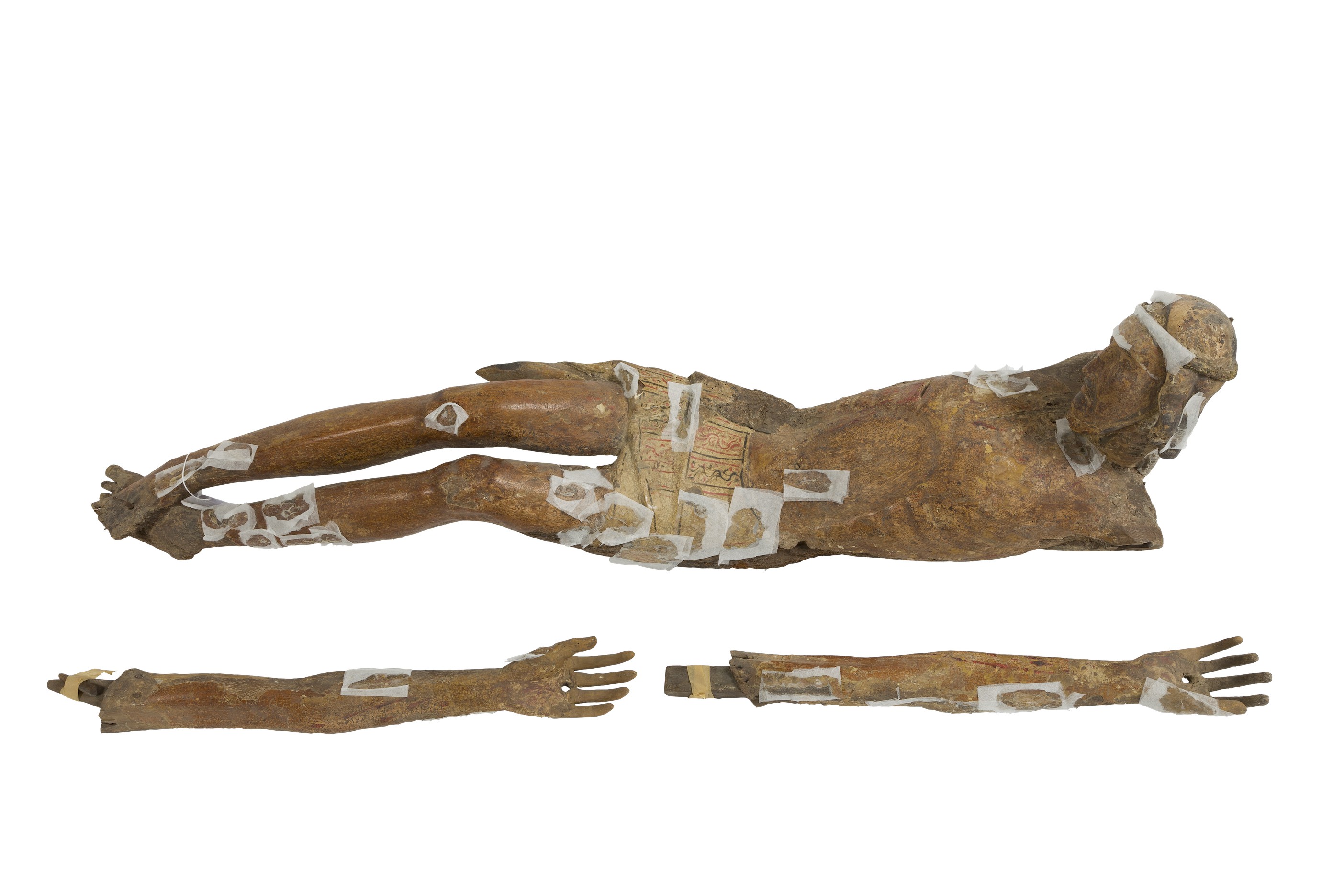
The crucifix is depicted according to the iconography of the Christus Patiens: dead and hung on the cross with 3 nails, the feet overlapping and pierced by a single nail. This typology of the dead Christ favors the aspect of the humanity of Jesus, emphasizing not so much his victory over death, but the sufferings he endured as a man during the Passion and ending by his dying on the cross to redeem mankind from sin. Such images, larger than life, brought believers closer to the incarnate and suffering God.
For this crucifix, the head is resting on the left shoulder, with closed eyes and mouth abandoned in the sleep of death. On the head of Christ rests the crown formed by two intertwined branches, now almost completely missing their thorns. The face expresses silent pain; the body is slender, built without pronounced muscular structure.
The body was not arched on the cross (now lost), but rather straight; the same applies for the legs, which are rigidly closed without touching each other except at the point where the feet overlap. The feet are very damaged from the weight of the wooden statue, and the nails that affixed the sculpture to the cross. It is attested that during the Middle Ages some crucifixes possessed a particular device on the shoulders and had movable arms. This suggests a special use for the sculpture during Lent. For the celebrations of Good Friday, the sculpture was removed from the cross and placed in the crypt. The arms of the crucifix seem too well preserved to be of the original workmanship. This is evident when comparing them to the extremely damaged feet.
The restoration will provide an opportunity to explore these aspects and to verify the cultural heritage of the sculpture: the modeled refinement and realistic content for the anatomy seems to lead to the identity of an unknown carver in central Italy, perhaps Tuscany, at the beginning of the fourteenth century.
State of Preservation
The conservation of the piece is provisional both for the state of its wood and for its painted surface. The wood has been ruined by xylophagous insects. The pigment blend not only has a soiled surface, but cohesion problems concerning the camotta technique.
Restoration Procedures
- Wooden framework consolidation
- Restorations of missing parts
- Pigment blend consolidation
- General cleaning
- Final polishing
- GRS analysis
- Photographic documentation
Detail
Inventory N°: 42382
Artist: Unknow, Italian
Date: Early XIV century
Dimensions: Height 160 cm
Materials: Polychrome carved wood
Department:
Byzantine - Medieval ArtWishbook year: 2019
Total Cost
€ 23,150

Christus Patiens Crucifix
Details
Adopted by: The Canada Chapter
Patrons: Mr. Michael Charles
Inventory: 42382
Artist: Unknow, Italian
Date: Early XIV century
Classification: Sculpture
Materials: Polychrome carved wood
Dimensions: Height 160 cm
Department: Byzantine - Medieval Art
Wishbook year: 2019
Description
The ancient provenance of this crucifix is unknown. The item was donated to the Vatican Museums by Pope Paul VI (Montini, 1963-1978) in 1978. The work belonged to a group of medieval and Renaissance wood sculptures acquired from the antiques dealer Nella Longari in Milan through the interest of his personal secretary Don Pasquale Macchi.
The crucifix is depicted according to the iconography of the Christus Patiens: dead and hung on the cross with 3 nails, the feet overlapping and pierced by a single nail. This typology of the dead Christ favors the aspect of the humanity of Jesus, emphasizing not so much his victory over death, but the sufferings he endured as a man during the Passion and ending by his dying on the cross to redeem mankind from sin. Such images, larger than life, brought believers closer to the incarnate and suffering God.
For this crucifix, the head is resting on the left shoulder, with closed eyes and mouth abandoned in the sleep of death. On the head of Christ rests the crown formed by two intertwined branches, now almost completely missing their thorns. The face expresses silent pain; the body is slender, built without pronounced muscular structure.
The body was not arched on the cross (now lost), but rather straight; the same applies for the legs, which are rigidly closed without touching each other except at the point where the feet overlap. The feet are very damaged from the weight of the wooden statue, and the nails that affixed the sculpture to the cross. It is attested that during the Middle Ages some crucifixes possessed a particular device on the shoulders and had movable arms. This suggests a special use for the sculpture during Lent. For the celebrations of Good Friday, the sculpture was removed from the cross and placed in the crypt. The arms of the crucifix seem too well preserved to be of the original workmanship. This is evident when comparing them to the extremely damaged feet.
The restoration will provide an opportunity to explore these aspects and to verify the cultural heritage of the sculpture: the modeled refinement and realistic content for the anatomy seems to lead to the identity of an unknown carver in central Italy, perhaps Tuscany, at the beginning of the fourteenth century.
State of Preservation
The conservation of the piece is provisional both for the state of its wood and for its painted surface. The wood has been ruined by xylophagous insects. The pigment blend not only has a soiled surface, but cohesion problems concerning the camotta technique.
Restoration Procedures
- Wooden framework consolidation
- Restorations of missing parts
- Pigment blend consolidation
- General cleaning
- Final polishing
- GRS analysis
- Photographic documentation
Media
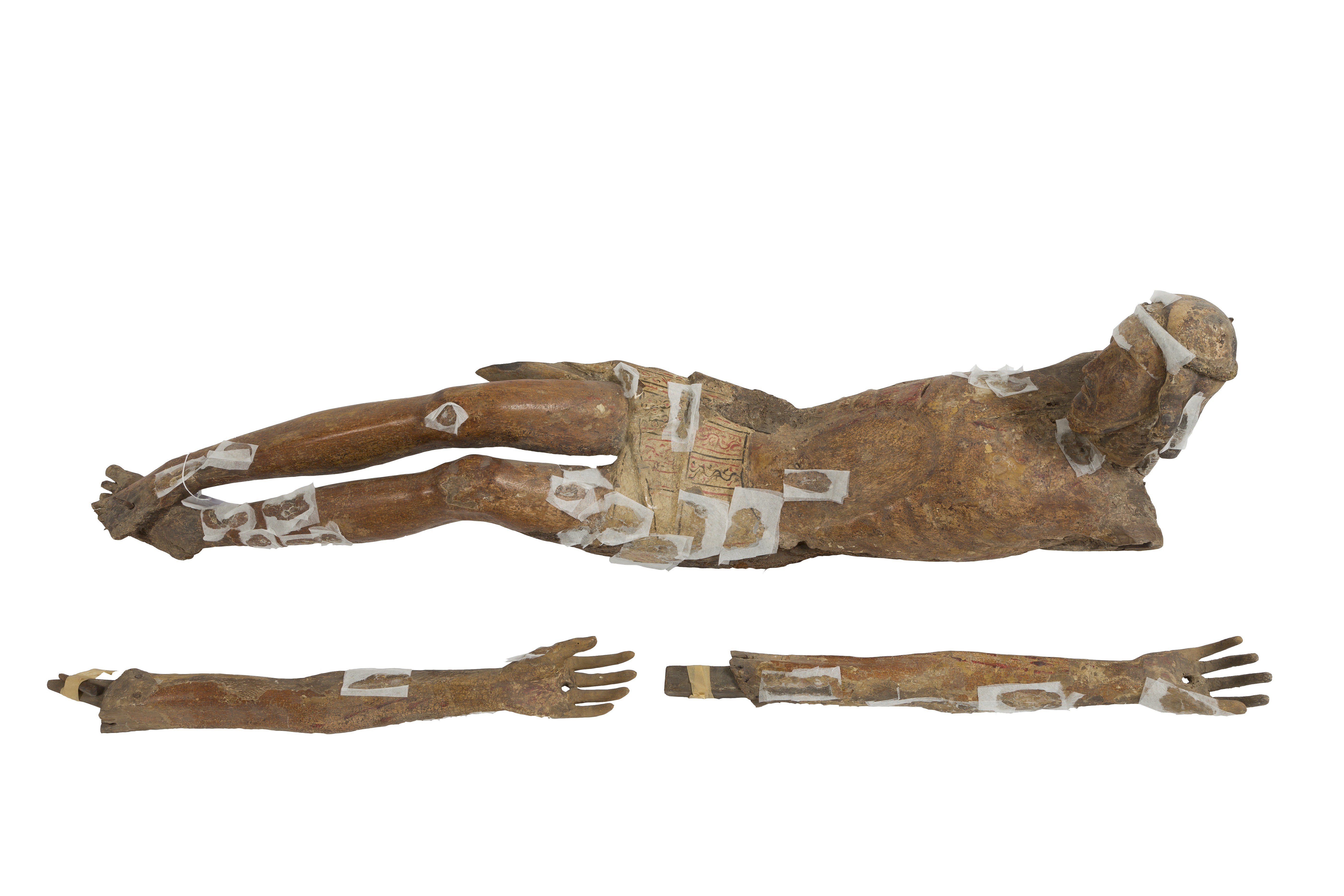
Christus Patiens Crucifix - Before Restoration
© 2026 Patrons of the Arts
in the Vatican Museums
Vatican Museums V-00120,
Vatican City State (Europe)
+39 0669864499