

Russian Icon of St. Nicholas
Artist: Unknown artist from the Russian School
Date: End of XV century - begnning of XVI century
Classification: Icon
Dimensions: 68 x 54 cm
Materials: Tempera on panel, Cover in silver, Gold filigree with overlapping metal plates
Adopted By: The Washington D.C. Chapter
Total Cost: € 21,500
Description
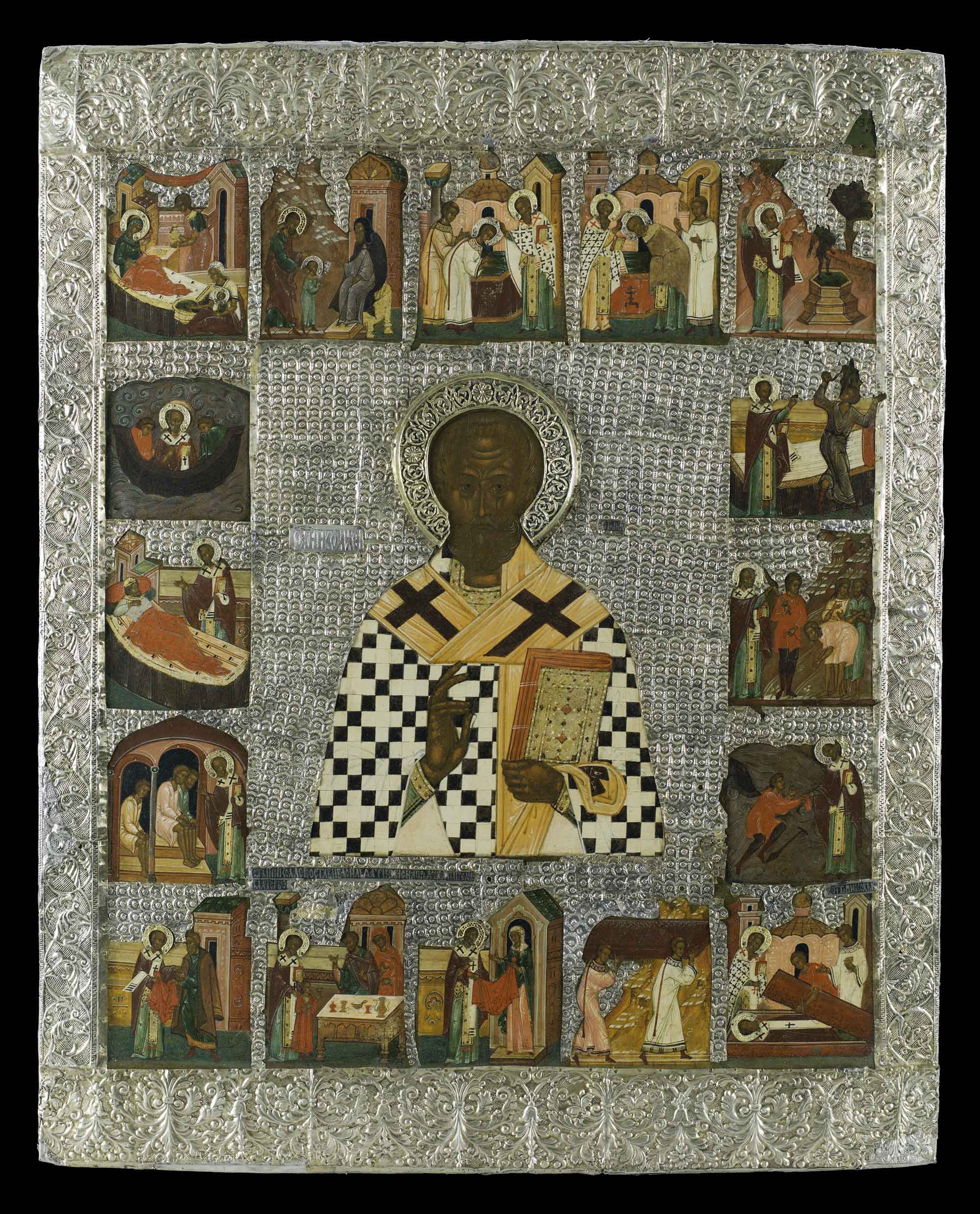
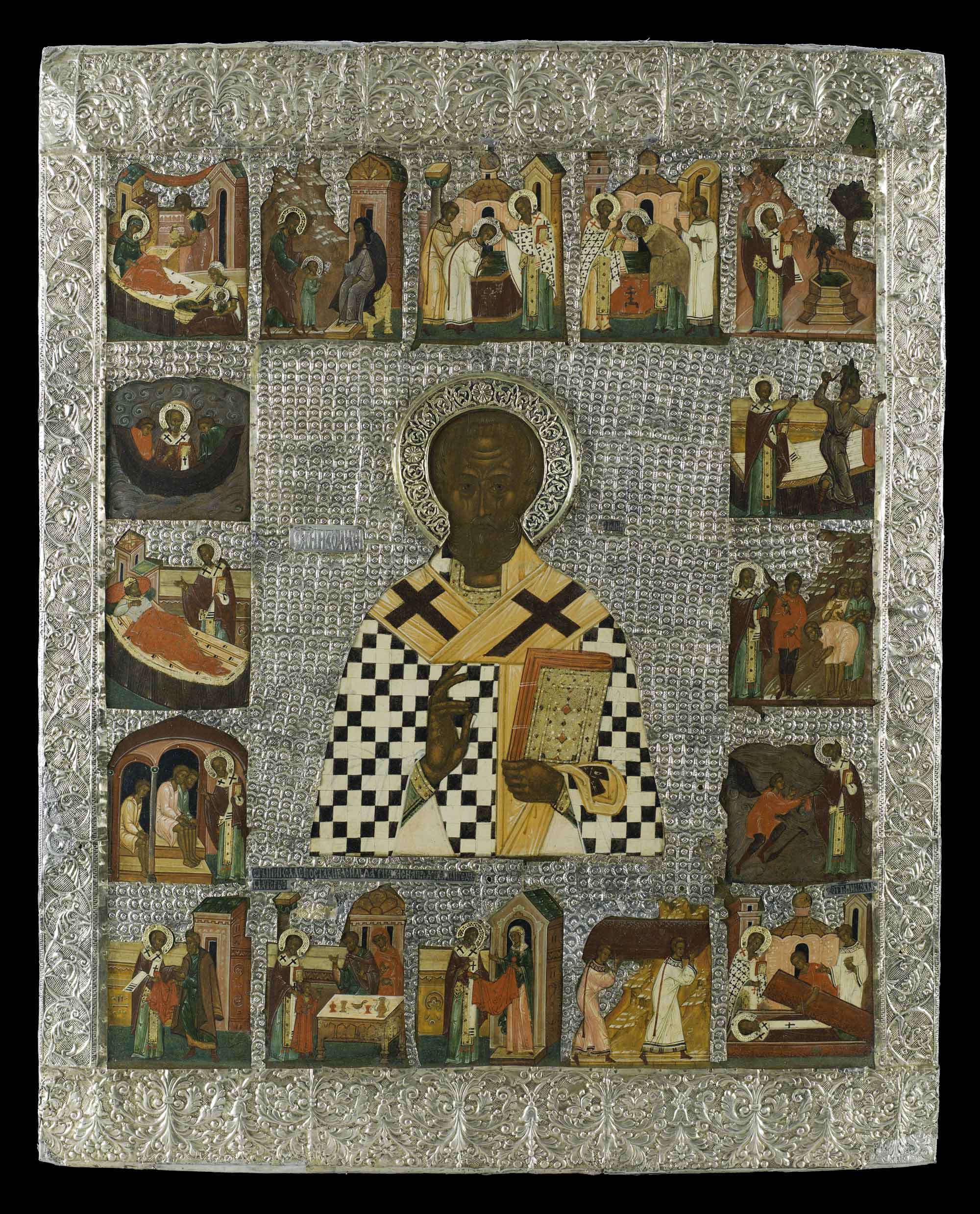
The precious Russian icon depicting Saint Nicholas and sixteen episodes of his life is coated in embossed silver with a filigree halo around the head of the saint in each of the scenes that surround the golden center. The saint is one of the most venerated in Europe and the Christian Orient, especially in the Greek and Slavic world, and was the Bishop of Myra in Lycia, where he died between 345 and 352. His relics were stolen and brought to Bari in 1087. From the first Byzantine icons dating to the 10th through 13th centuries, the iconographic cycle became enriched in Russia with new episodes like the painting in the Vatican of Rescuing the child Demetrius from the waters of the river Dnepr. In this icon, St. Nicholas is represented in the center in his typical iconographic style: a half-bust dressed as a bishop wrapped in an omophorion decorated with crosses, giving a blessing with the Gospel in his hand. The central image is surrounded by sixteen episodes in the life of the saint: Birth of the saint, The saintly child is brought to school by a Monk, Diacatent Ordination, Priestly Ordination, The saint frees a madman from a demon, the saint saves a ship from sinking, Healing of demoniac, Emperor Constantine appears in a dream, Saving three officers from decapitation, Freeing three sentenced to death, Saving the castaway Demetrius, Giving a father the dowry for his daughters, Returning little Basil to his parents, Making the miracle on the little carpet, Funeral of the saint, and Burial of the saint. The painting is excellently executed and approaches the school of Novgorod. It can be dated between the end of the 15th century and the beginning of the 16th century. The silver cover may date back to 1571, the date of the first dedication of the icon as written on the back in ancient Slavic language. Also, the dedicatory writing located on the back of the painting provides other interesting details about its story. The Slavic language mentions the princess Eudochia, daughter of Russian prince Michele Andreevic Dimitrijevic Godunov. The prince gave the icon to a monastery in 1571 in memory of his brother Giovanni. The Latin inscription informs us that Francesco Vettori, prefect, and curator of the Sacred Vatican Museum, gave the painting to Pope Clement XIII for the occasion of his visit on April 2nd, 1763. Invaluable for the reconstructed icon is the engraving of Agincourt in 1824-1825.
State of Preservation
The silver leaf was uniformly oxidized, mostly in points tampered with during previous interventions. The perimetric frame, decorated with foliage, was structurally in the best condition, while internal partitions of the panel appeared to be disjointed, incomplete, raised, and fractured in many areas. Numerous iron nails, unlike the original silver, were corroded and harmful to the surrounding surfaces.
Restoration Procedures
- Disassemble the detail of plates after a mapping graphic of the sequence of the disassembly
- Photographic documentation
- Cleaning with a pad and/or immersion of the oxidized surfaces
- Washing and dehydration
- Removal and replacement of non-original iron nails with silver nails
- Protective varnishes
- Reassembly
Detail
Inventory N°: 40026
Artist: Unknown artist from the Russian School
Date: End of XV century - begnning of XVI century
Dimensions: 68 x 54 cm
Materials: Tempera on panel, Cover in silver, Gold filigree with overlapping metal plates
Department:
Byzantine - Medieval ArtWishbook year: 2011
Total Cost
€ 21,500

Russian Icon of St. Nicholas
Details
Adopted by: The Washington D.C. Chapter
Patrons: Mr. Watson
Inventory: 40026
Artist: Unknown artist from the Russian School
Date: End of XV century - begnning of XVI century
Classification: Icon
Materials: Tempera on panel, Cover in silver, Gold filigree with overlapping metal plates
Dimensions: 68 x 54 cm
Museum: BAV Gallery of the Ancient Library
Department: Byzantine - Medieval Art
Laboratory: Metals & Ceramics, Painting & Wood
Wishbook year: 2011
Description
The precious Russian icon depicting Saint Nicholas and sixteen episodes of his life is coated in embossed silver with a filigree halo around the head of the saint in each of the scenes that surround the golden center. The saint is one of the most venerated in Europe and the Christian Orient, especially in the Greek and Slavic world, and was the Bishop of Myra in Lycia, where he died between 345 and 352. His relics were stolen and brought to Bari in 1087. From the first Byzantine icons dating to the 10th through 13th centuries, the iconographic cycle became enriched in Russia with new episodes like the painting in the Vatican of Rescuing the child Demetrius from the waters of the river Dnepr. In this icon, St. Nicholas is represented in the center in his typical iconographic style: a half-bust dressed as a bishop wrapped in an omophorion decorated with crosses, giving a blessing with the Gospel in his hand. The central image is surrounded by sixteen episodes in the life of the saint: Birth of the saint, The saintly child is brought to school by a Monk, Diacatent Ordination, Priestly Ordination, The saint frees a madman from a demon, the saint saves a ship from sinking, Healing of demoniac, Emperor Constantine appears in a dream, Saving three officers from decapitation, Freeing three sentenced to death, Saving the castaway Demetrius, Giving a father the dowry for his daughters, Returning little Basil to his parents, Making the miracle on the little carpet, Funeral of the saint, and Burial of the saint. The painting is excellently executed and approaches the school of Novgorod. It can be dated between the end of the 15th century and the beginning of the 16th century. The silver cover may date back to 1571, the date of the first dedication of the icon as written on the back in ancient Slavic language. Also, the dedicatory writing located on the back of the painting provides other interesting details about its story. The Slavic language mentions the princess Eudochia, daughter of Russian prince Michele Andreevic Dimitrijevic Godunov. The prince gave the icon to a monastery in 1571 in memory of his brother Giovanni. The Latin inscription informs us that Francesco Vettori, prefect, and curator of the Sacred Vatican Museum, gave the painting to Pope Clement XIII for the occasion of his visit on April 2nd, 1763. Invaluable for the reconstructed icon is the engraving of Agincourt in 1824-1825.
State of Preservation
The silver leaf was uniformly oxidized, mostly in points tampered with during previous interventions. The perimetric frame, decorated with foliage, was structurally in the best condition, while internal partitions of the panel appeared to be disjointed, incomplete, raised, and fractured in many areas. Numerous iron nails, unlike the original silver, were corroded and harmful to the surrounding surfaces.
Restoration Procedures
- Disassemble the detail of plates after a mapping graphic of the sequence of the disassembly
- Photographic documentation
- Cleaning with a pad and/or immersion of the oxidized surfaces
- Washing and dehydration
- Removal and replacement of non-original iron nails with silver nails
- Protective varnishes
- Reassembly
Media
Russian Icon of St. Nicholas
© 2026 Patrons of the Arts
in the Vatican Museums
Vatican Museums V-00120,
Vatican City State (Europe)
+39 0669864499