

Pontifical Sanctuary of the Holy Stairs
Artist: Various
Classification: Architectural
Adopted By: The Illinois Chapter, The Texas Chapter
Description
One of the most important holy sites in Christianity, the Holy Stairs, or Scala Santa, are said to be the same steps in Jerusalem mounted by Christ before he was judged by Pontius Pilate. They were brought to Rome in 326 AD by St.Helena, mother of Emperor Constantine and placed near their current site on land donated to the Early Church by the Emperor. In 1277, when the Lateran was still the papal residence, the Sancta Sanctorum, or “Holiest of Holy Places” was constructed as the private chapel for the popes.
The chapel is not alone in the complex of the Holy Stairs. To its one side is the Chapel of St. Lawrence, dedicated to the martyr who believed that the suffering, blind, and crippled were treasures of the Church. On the other side resides the chapel of St. Sylvester, the pope to whom Constantine dedicated the Lateran area during his empire. These chapels are places filled with countless prayers,innumerable relics, and saintly frescoes.
Millions of pilgrims have since paid homage to this devotional site, and continue to do so today. In a disposition of sincere humility, one must ascend the stairs on their knees. Any visitor who witnesses the devotion with which the faithful ascend the Holy Stairs, remains in awe of the prayerful dedication to the Passion of Christ.
Building a properly enclosed structure around the Scala Santa was one of the major projects inaugurated by Pope Sixtus V in 1590 and eventually completed by architect Domenico Fontana. The Holy Pontiff also hired a team of forty artists to decorate the interior vaults and stairwells. Cesare Nebbia and Giovanni Guerra headed the multivariate group. Today, the stairs contain more than 1700 square meters of frescoes telling the story of the Old and New Testaments. Various saints and doctors of the church make their debut next to superb landscapes by Flemish master, Paul Brill.
These cycles were executed in a style that came to be known as the Late Mannerism movement, which was to influence the development of figurative painting in Rome for years to come.
The Passionist Fathers became custodians of this extra-territorial domain of the Holy See and took up plans to completely restore its chapels and frescoed walls that had suffered significant deterioration over the centuries.
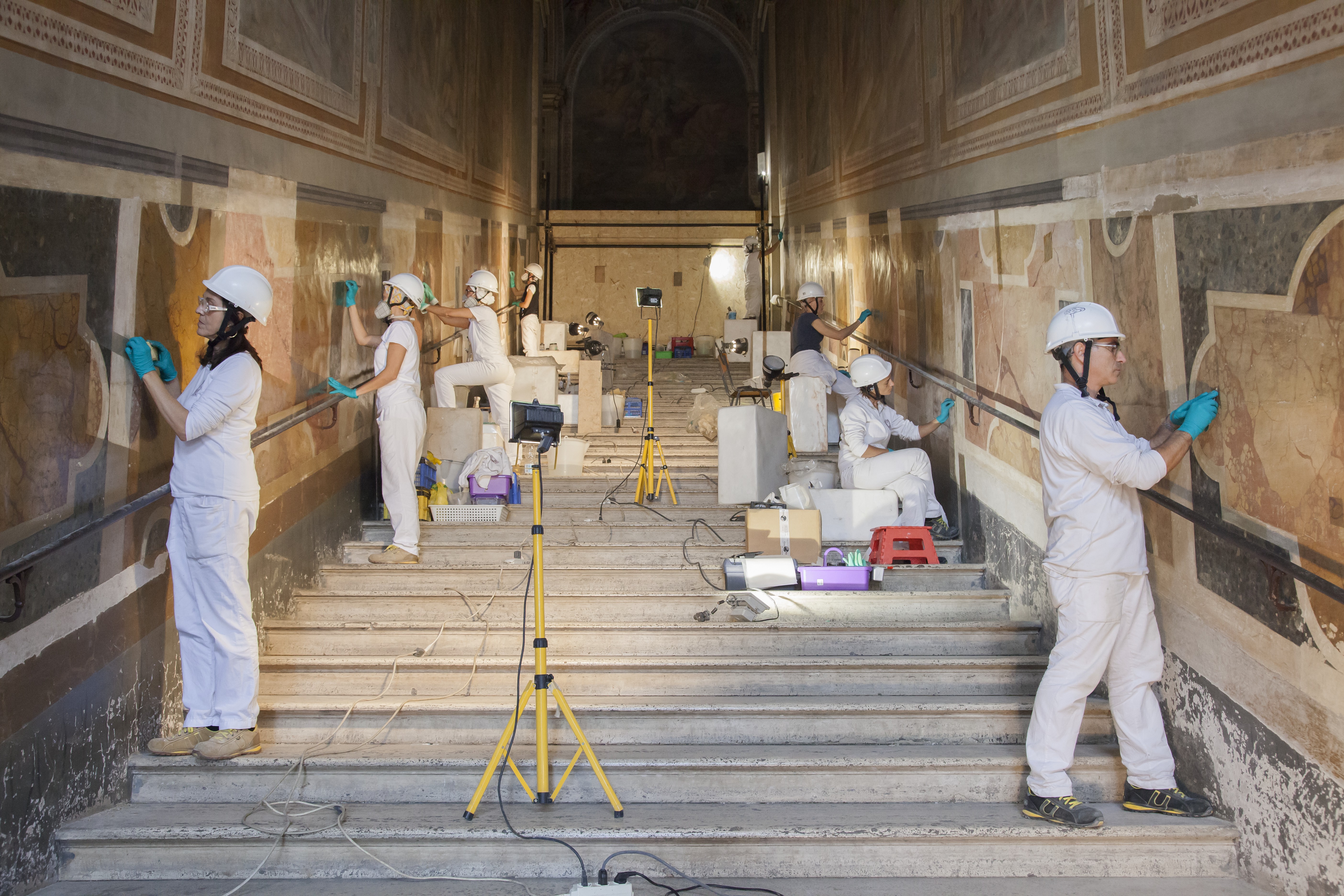
After a major collaboration with the Getty Foundation in 2000 to restore the Chapel of Saint Sylvester, a campaign to “Save the Stairs” began in 2012, and responsibility for restoration was transferred completely into the hands of the Vatican Museums. Donations from the Patrons of the Arts raised partial funding for the project enabling 3/5 of the five phase enterprise to be restored. The blackened walls almost miraculously dissipated as the work of the nine-membered team elicited forth the dazzling colors of the 16th century frescoes.

Pontifical Sanctuary of the Holy Stairs
Details
Adopted by: The Illinois Chapter, The Texas Chapter
Artist: Various
Classification: Architectural
Wishbook year: 2000
Description
One of the most important holy sites in Christianity, the Holy Stairs, or Scala Santa, are said to be the same steps in Jerusalem mounted by Christ before he was judged by Pontius Pilate. They were brought to Rome in 326 AD by St.Helena, mother of Emperor Constantine and placed near their current site on land donated to the Early Church by the Emperor. In 1277, when the Lateran was still the papal residence, the Sancta Sanctorum, or “Holiest of Holy Places” was constructed as the private chapel for the popes.
The chapel is not alone in the complex of the Holy Stairs. To its one side is the Chapel of St. Lawrence, dedicated to the martyr who believed that the suffering, blind, and crippled were treasures of the Church. On the other side resides the chapel of St. Sylvester, the pope to whom Constantine dedicated the Lateran area during his empire. These chapels are places filled with countless prayers,innumerable relics, and saintly frescoes.
Millions of pilgrims have since paid homage to this devotional site, and continue to do so today. In a disposition of sincere humility, one must ascend the stairs on their knees. Any visitor who witnesses the devotion with which the faithful ascend the Holy Stairs, remains in awe of the prayerful dedication to the Passion of Christ.
Building a properly enclosed structure around the Scala Santa was one of the major projects inaugurated by Pope Sixtus V in 1590 and eventually completed by architect Domenico Fontana. The Holy Pontiff also hired a team of forty artists to decorate the interior vaults and stairwells. Cesare Nebbia and Giovanni Guerra headed the multivariate group. Today, the stairs contain more than 1700 square meters of frescoes telling the story of the Old and New Testaments. Various saints and doctors of the church make their debut next to superb landscapes by Flemish master, Paul Brill.
These cycles were executed in a style that came to be known as the Late Mannerism movement, which was to influence the development of figurative painting in Rome for years to come.
The Passionist Fathers became custodians of this extra-territorial domain of the Holy See and took up plans to completely restore its chapels and frescoed walls that had suffered significant deterioration over the centuries.
After a major collaboration with the Getty Foundation in 2000 to restore the Chapel of Saint Sylvester, a campaign to “Save the Stairs” began in 2012, and responsibility for restoration was transferred completely into the hands of the Vatican Museums. Donations from the Patrons of the Arts raised partial funding for the project enabling 3/5 of the five phase enterprise to be restored. The blackened walls almost miraculously dissipated as the work of the nine-membered team elicited forth the dazzling colors of the 16th century frescoes.
© 2026 Patrons of the Arts
in the Vatican Museums
Vatican Museums V-00120,
Vatican City State (Europe)
+39 0669864499